
Buyer's guide
Antique Identifier App: What They Do and How to Choose One
An antique identifier app photographs an object and returns a description of it and, usually, a price range. This page covers how that actually works, what separates a result worth reading from one worth nothing, and the questions worth asking before you let any of them put a figure on something you own.
It is published by Eversight, which makes RelicLens, one of these apps. There is a section below that says plainly what RelicLens returns and what it cannot do. Read the rest as a description of the category written by someone who has had to build the unglamorous parts of it.
Last reviewed 7 September 2026
What an antique identifier app actually does
It compares a photograph against a large body of images, catalog descriptions and sale listings, and returns the closest reading it can support. It does not examine your object.
That distinction is the whole story of the category. An appraiser picks a piece up. Weight, the ring a ceramic body gives when tapped, the temperature of glass against a hand, the feel of a foot rim, the join under a chair seat, whether a screw was cut by hand: none of that reaches a camera. What does reach a camera is form, proportion, decoration, color, surface and wear, and those carry a surprising amount of an identification, because they are also what a specialist uses in the first three seconds. An app is working from a real but partial signal, and the useful ones are built as though that were true.
How photo identification works, end to end
Five steps: capture, separation, description, retrieval, and a range derived from what was retrieved. The two that decide whether the answer is any use are the last two, and they are the two least often described.
- Capture. You photograph the object or choose a picture already in your library. Everything downstream inherits the limits of this frame, which is why a distant or soft photograph costs more accuracy than a cluttered background does.
- Separation. The object is cut away from its background so the model is reading the piece rather than the room. RelicLens does this on the device, which means the picture that leaves your phone is the object and not your kitchen table.
- Description. A model returns what the object appears to be: a category, a likely period, an origin, materials, a condition read. This is the step people imagine is the whole app.
- Retrieval. That description becomes a query against listings and sale records, looking for pieces that resemble yours. This is where tools separate, and where an app either has real data behind it or does not.
- Range. A low and a high estimate come out of the comparables that were found. A figure produced without comparables behind it cannot be checked by anyone, including whoever produced it.
A step by step walk through of a single photograph, from framing to finished report, is on the identify antiques by photo page, and how we build a range out of retrieved comparables is written up on the methodology page.
What separates a useful result from a worthless one
You can check a useful result. That is the entire test, and it is worth applying in the first minute rather than the first month.
Comparable listings you can open. A number on its own cannot be argued with. A handful of listings for similar pieces, each with a price and the marketplace it came from, can: you open them, read what the seller declared about condition, and decide how close a match each one really is. Sometimes you will conclude the estimate is optimistic. That is the tool working, not failing.
A range rather than a point. Antiques do not have prices, they have ranges, and the range moves with condition, completeness, provenance and who happens to be in the room on the day. A single confident figure is a stylistic choice, not a more precise answer.
Named fields rather than adjectives. A period, an origin, a materials read, a category and a condition grade are five separate claims, and you can check them one at a time against the object in front of you. A paragraph of warm description is one claim you can only accept or reject whole.
Evidence rather than a percentage. A confidence score is generated by the same process that produced the answer, so there is no way to check it from outside. Comparable listings are the better signal, because you can open them and judge the match yourself. That is the approach RelicLens takes: every report shows the pieces the range was drawn from.
The questions to ask before trusting one with something you own
Six of them, and if an App Store listing cannot answer them, that is the answer.
- Does it show its evidence? Look for comparable listings you can open in a browser, not a screenshot of a chart. If the only output is a number, there is nothing to check.
- Does it claim to authenticate? If an app says it verifies authenticity, or tells genuine from fake, stop there. Authentication is a physical and documentary process. An app claiming it is either using the word loosely or does not know what it means, and neither is a good sign.
- What happens to your photograph? Whether the image leaves the device, what it is used for afterward, whether it is attached to an account, and where the finished report is stored.
- What does free actually mean? Free covers at least three different arrangements: a free download with every result behind a subscription, a fixed number of results at no cost, and a trial that converts to a subscription. Find the sentence that says which one you are looking at before you photograph anything.
- Can you get the result out? Whether a report can be shared, exported or copied matters the first time you want to show it to a relative or hand it to an appraiser.
- Who publishes it, and on what? A named publisher, a reachable support address, a stated platform and a minimum operating system version. An app with no reachable human behind it is not one to lean on when it matters.
What showing the evidence looks like
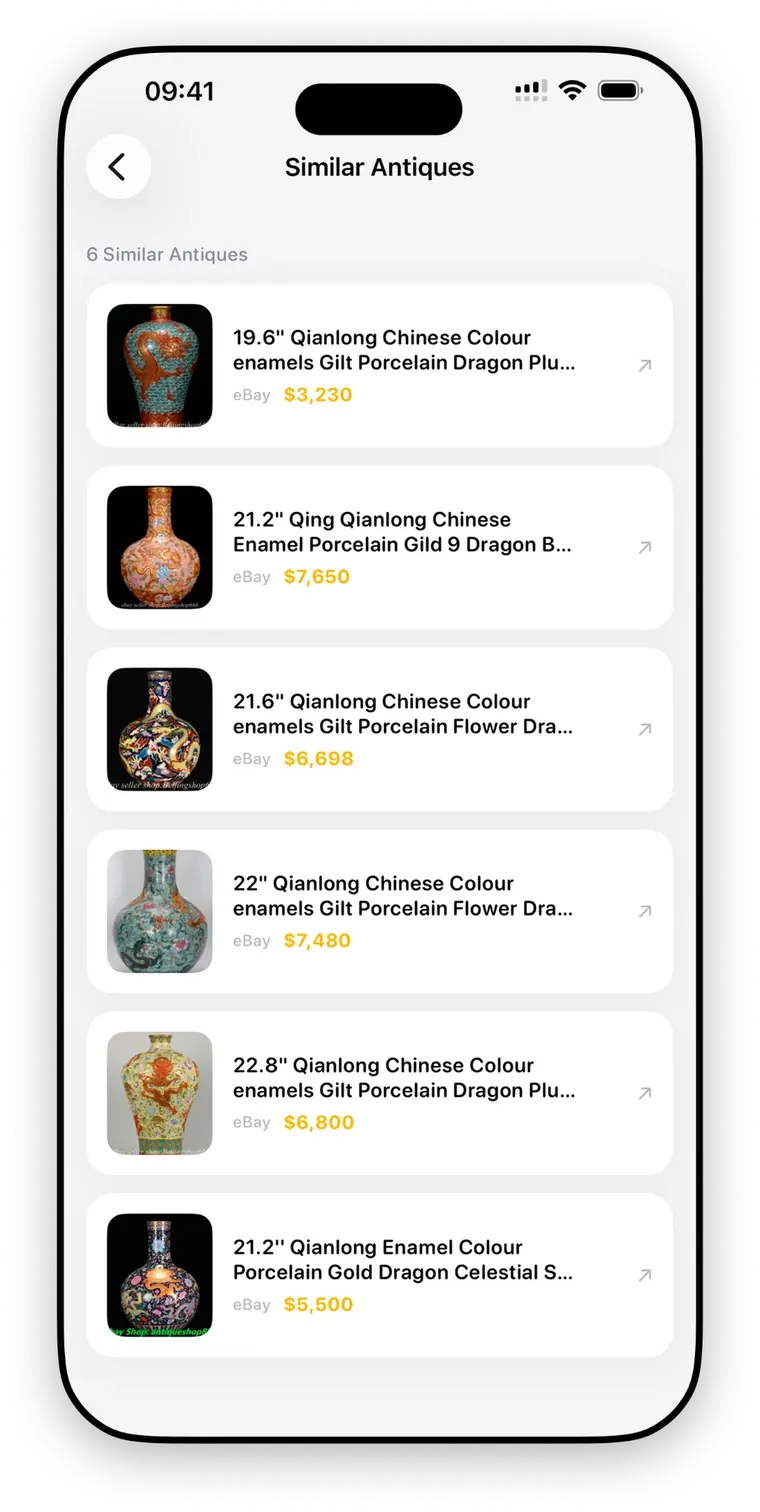
It looks like a list you can leave the app with. Each comparable carries a thumbnail, a title, the marketplace it was listed on and its asking price, and tapping one opens the listing in your browser.
That is the part of a report that can be wrong in public. If the pieces behind an estimate are obviously not your object, you have learned something about the estimate in a few seconds, and you have learned it from the app rather than after paying someone. A tool that hides this step is asking for a kind of trust that nothing working from a photograph has earned.
Where these apps help, and where they do not
They help when you have many objects, little time and no baseline. They do not help anywhere a document is required or a dispute is possible, which covers most of the situations where money actually changes hands.
The useful cases have a shape in common: the alternative is knowing nothing at all. Standing at a table of forty objects with ten minutes before someone else buys them, a rough read on four of them is worth more than a perfect read on none. Holding a piece nobody in the family can date, a period and a material give you the words to search with, which is often the real blocker. The unhelpful cases have a shape in common too: somebody other than you has to accept the number.
| Situation | What an app can give you | What the situation requires |
|---|---|---|
| Deciding whether to buy at a flea market or estate sale | A category, a rough period and a price range for pieces that look similar, in about a minute, standing up. | Usually nothing more. This is the case the whole category was built for. |
| A first read on an inherited piece | Vocabulary. What family the object belongs to, what it appears to be made of, and roughly when it was made. | A specialist opinion before anything is sold, split between people, or thrown out. |
| Insuring a piece | A rough sense of whether the piece is worth scheduling separately at all. | A written appraisal from a qualified appraiser, stating a defined value type and dated. |
| Probate or estate division | A working inventory with rough figures, which is genuinely useful for making sure nothing is discarded by accident. | An appraisal a court, an executor or a tax authority will accept, which means a qualified appraiser. |
| Auction consignment | An idea of whether a piece is likely to clear a saleroom minimum before you drive there. | The auction house estimate, made by a specialist with the object in hand. |
| Settling whether a piece is genuine | Nothing you should rely on. | Physical examination by someone who knows the material, and often documentation of where the piece has been. |
Are antique identifier apps legitimate?
The software is real and it does a real, narrow thing. The question worth asking is not whether the category is a scam, but whether the specific claim in front of you is one a photograph can support.
The category has earned some of its suspicion. Listings promise appraisals, certificates and authentication, none of which a photograph produces. Some apps charge before showing anything at all. Some return a figure and no evidence, which is unfalsifiable by design. And a value estimate is the kind of output people want to believe, which makes it the easiest thing in the category to sell badly.
What a well built tool does give you, from one photograph, is the family of object you are holding, roughly when and where it was made, what it appears to be made of, and what comparable pieces are being asked for. When the alternative is a guess, that is the difference between walking away from something good and recognizing it.
The practical test takes a minute. Run one object, then open the comparables. If they are pieces you would accept as similar, the tool is doing its job. If they are a random sweep of the category, you have learned what that tool is worth before trusting it with anything that matters.
RelicLens, which we publish
This page is published by Eversight Studio LLC, which makes RelicLens, so here is RelicLens held to the same questions as everything above.
What a report returns. From one photograph: a category, one of eight (Silver & Metalwork, Ceramics, Glassware, Furniture, Jewelry, Sculpture, Decorative Object, Collectible); the likely period, origin and materials as free text; a condition grade on five levels from poor to excellent; a rarity read on five levels from common to exceptional; a reference value with a low and a high estimate either side of it; and comparable listings with prices and the marketplace they came from, which open in your browser. Every report is saved to a collection on the device that keeps a running estimated total.
What one free report means. One full report, once, held against the device rather than an account, so reinstalling the app does not reset it. RelicLens includes one full report free. A subscription is what lets you run more of them; it does not add fields to a report or unlock anything in your collection.
What it does not do. It does not read text, so hallmarks, maker marks, signatures and inscriptions are not transcribed. It gives no confidence score and no verdict on whether a piece is genuine. It offers no care, cleaning or restoration advice. There is no export, and no way to search, tag or filter a collection. Identification runs on a server, so it needs an internet connection. And it runs on iPhone and iPad, iOS 17.0 or later, with no Android, web or desktop version.
Who to reach. The publisher is Eversight Studio LLC and support is one address, hello@eversight.io, read by a person. The App Store shows 4.6 out of 5 from 56 ratings. The official app page collects the store listing, the publisher and the support address in one place, which is how to tell the real listing from something copying it.
Further reading on this site
The pages below go deeper on the mechanics, on what a value actually means, and on the two places people most often get hurt: buying reproductions, and inheriting something with no paperwork.
- Identify antiques by photo, which walks one photograph through to a finished report.
- Methodology, on where a value range comes from and what it is not.
- Antique marks identification, a reference for the marks no app can read for you.
- How AI is used in antique appraisal, on what the technology does and does not change.
- How much is my antique worth, five ways to estimate a value, only one of which is an app.
- How to spot fake antiques, the physical checks a photograph cannot make.
- Inherited antiques and what they are worth, where an app is a first step and not the last one.
Questions people ask before installing one
Are antique identifier apps legitimate?
The software is real and the narrow claim behind it is real: from a photograph, one of these apps can usually tell you what family of object you are holding, roughly when and where it was made, what it appears to be made of, and what similar pieces are being asked for. The claims that are not real are the ones that reach past what a photograph carries: appraisal, certification, authentication, a verdict on whether a piece is genuine. Judge a specific app on whether it hands you evidence you can open and check, and on whether it says plainly what free covers before you photograph anything.
Do antique identifier apps really work?
For narrowing an unknown object down to a family, a period and a material, they work often enough to be worth the minute they take. For putting an exact figure on a specific object, treat every result as a hypothesis. A photograph carries form, proportion, decoration, color, surface and wear. It does not carry weight, the sound a ceramic body makes, the feel of a foot rim, the join under a chair seat, or anything on a side you did not photograph. The result worth more trust is the one that arrives with comparable listings you can open, because then you can see for yourself whether the pieces behind the number resemble yours.
Can an app authenticate an antique or spot a fake?
Authentication is a physical examination that carries a professional name behind it, and it sits outside what any photo-based tool does. What RelicLens gives you is the identification and the market: the likely period, origin and materials, a condition grade, a rarity read, a value range and the comparable listings behind it. If an app claims to verify authenticity from a picture, treat that claim carefully.
What should I look for in the result an app gives me?
Evidence and a range. Comparable listings that open in your browser let you judge a number instead of accepting it, and a low and high estimate is a more honest shape than a single figure, because condition, completeness and provenance move antique prices a long way. Named fields help too: a period, an origin, a materials read and a condition grade are separate claims you can check one at a time, where a paragraph of confident description is one claim you can only take or leave whole.
What happens to the photo I take?
With RelicLens, the object is separated from its background on the device, and that cut out image is what reaches the server which runs the identification, so identification needs an internet connection. There is no account and no sign in, and a finished report and its image are stored on the device rather than in a cloud copy. When you are weighing any app in this category, that is the shape of the question worth asking: what leaves the device, what it is used for afterward, and whether it is attached to an identity.
Is there an antique identifier app for Android?
Not from us. RelicLens runs on iPhone and iPad, on iOS 17.0 or later, and there is no Android, web or desktop version. Other apps in the category do publish for Android, and the questions on this page apply to them unchanged: whether they show comparable listings you can open, what they claim about authentication, what happens to your photograph, and what free actually covers.
See what one report actually contains.
Rather than take a description of the category on trust, run something through it. RelicLens includes one full report free, once per device, and every field a report can contain is in that free one.
Download on the App Store