
Value estimator
Antique Value Estimator: Get a Range in Seconds
Photograph a piece and RelicLens returns a reference value with a low and a high estimate either side of it, plus the comparable listings the range was built from. This page explains how that range is assembled, what pushes it up or down, and how to read it.
Last reviewed 7 September 2026
The short answer
A value estimate is a comparison. You establish what an object is, you find what comparable objects are changing hands for, and the spread across those comparables is your answer. A tool speeds up both halves of that: it describes the piece from a photograph, and it puts the comparable listings in front of you so the range has evidence attached rather than authority behind it.
That is the whole method, and it is worth knowing because it tells you how to judge any figure you are given. Ask what it was compared against. If the answer is visible, you can check it in a minute. If it is not, the number is an opinion wearing a decimal point.
How the range is built
Everything starts with the description, not the price. A photograph carries silhouette, proportion, decoration, surface, glaze texture, wear patterns and the shape of details like a foot, a handle or a hinge. Those are the same signals a specialist reads across a room at a fair, and they are enough to place most pieces in a tradition and a period.
From that description comes a set of comparable listings: pieces of the same form, made in the same tradition, offered in a condition close to the one in your photograph. Each comparable carries an asking price and the marketplace it came from, and each one opens in your browser so you can read the seller’s own description of what they are offering.
The comparables define the range. Where they cluster tightly, the low and high estimates sit close together and the reference value in the middle carries real weight. Where they scatter, the range opens up, and that width is itself a finding: it means the form trades across a broad market and the exact figure depends on details the photograph cannot settle on its own, usually condition or a maker.
Rarity and condition are read at the same time, each on a five-level scale, from common to exceptional and from poor to excellent. Those two reads are what position your piece inside the range rather than merely somewhere within it. A comparable in excellent condition and yours graded good tells you to expect the lower half.
What moves the price
Ten factors do most of the work. The direction and the force are what matter here: the exact percentages differ by category, by country and by year, and anyone quoting a fixed multiplier for all antiques is guessing. What holds across categories is which way each factor pushes and how hard.
| Factor | Direction | Force | Why it moves the number |
|---|---|---|---|
| Rarity | Up | Strong | Every step up the five-level scale from common to exceptional shrinks the supply a buyer can choose from, and the price climbs with it. Rarity is the one factor that can multiply a figure rather than adjust it. |
| Condition | Either way | Strong | The same form in excellent condition and in fair condition are two different objects to the market. Condition moves the number further than anything except rarity, and it moves it in both directions. |
| Named maker or workshop | Up | Strong | An attributable maker gives collectors a category to collect. A piece that can be placed with a known workshop competes in a market of people who already want that name. |
| Original surface and finish | Up when original | Strong | Untouched patina, an original glaze, an original lacquer or an original finish on wood are all paid for directly. A surface that has been replaced trades nearer the price of a decorative piece. |
| Provenance | Up | Moderate to strong | A documented chain of ownership turns a probable attribution into an established one. Its effect scales with how good the piece already is: it lifts a fine object far more than an ordinary one. |
| Completeness | Up | Moderate | A lid, a key, a pair, a matching set, the original case. Complete examples are scarcer than the individual parts suggest, and a set almost always sells above the sum of its pieces. |
| Repairs and replaced parts | Down | Moderate | A visible repair is priced in by every buyer who sees it. Replaced hardware, a later handle, a regilded rim and a resilvered mirror plate all pull the figure toward the lower estimate. |
| Size and practicality | Either way | Moderate | Objects that fit a modern room sell faster and higher than objects that need one built around them. Very large furniture and very heavy sculpture carry a shipping cost that buyers subtract before bidding. |
| Current taste | Either way | Moderate | Fashion moves value between categories without touching the objects. A style that decorators are buying this year clears at the top of its range; a style that is out of favor sits near the bottom of it. |
| Market timing and supply | Either way | Mild to moderate | When several comparable examples list in the same month they compete with each other, and the achievable price drifts down. A thin market with one example listed does the reverse. |
Reading a range rather than a single figure
The three numbers in a report are one statement, and the useful reading takes all three together. The reference value is the middle of a defensible range for a piece of that description in that apparent condition. The low estimate is roughly where a quick sale to a trade buyer lands. The high estimate is roughly where a patient sale to the right collector lands.
Which end applies to you depends less on the object than on how you plan to move it. Selling this weekend to whoever walks past is a low-estimate transaction. Listing it properly, photographed well, described with the correct terms, and waiting for the person who collects exactly that thing is a high-estimate transaction. Both are legitimate. Knowing which one you are running stops the range from feeling vague.
A wide range is also a prompt to look harder rather than a shrug. It usually means one specific fact would collapse it: a mark on the base, a maker’s label under a drawer, a date on a movement. Our page on antique marks identification covers where those live by object type and how to read the main families of them, and finding one often moves your estimate from the middle of the range to a defensible point near the top.
One habit is worth building: read the comparables before the number. Open two or three, check that the form really matches, check that the described condition really matches, and check the listing is current. When those three hold, the range is grounded, and you will trust the figure for the right reason.
A worked example, from photograph to range
Take the pocket watch in the report below, which is a real capture from the app. It is the kind of object that stalls people: clearly old, clearly made with care, and with nothing on the outside that tells a non-specialist what it is worth.
Step one, the photograph. A watch case is a curved reflective surface, so light it from the side rather than head on, and lay it flat against a plain background. The engraving on the case and the detail of the dial are what carry the identification, and both disappear under a flash.
Step two, the description. The report places the piece before it prices it. Category: collectible. Period: 1920s to 1930s. Origin: United States. The summary names it as an Elgin pocket watch with an engraved case and an Art Deco dial, typical of that era. Those are the words you could not have searched with, because they were the words you were missing.
Step three, the range. A reference value of $175, with a low estimate of $100 and a high estimate of $350. Beneath it, condition reads very good and rarity reads common. Read as one statement: a quick sale is a hundred-dollar transaction, a patient sale to somebody who collects American pocket watches is a three-hundred-and-fifty-dollar transaction, and $175 is the honest expectation in between.
Step four, the check. Open the comparable listings, each one a tap from the marketplace it is listed on. A cluster of similar watches around the middle of the range, with a couple of better examples above it, is exactly the shape that produces $100 to $350 with $175 in the middle. Checking it takes a minute, and it is the difference between having a number and knowing what the number is built on.
What a report contains
Every report carries the same fields, and the free one carries all of them:
- A reference value with a low and a high estimate on a gauge, in your device currency.
- A rarity read on five levels, with the reasoning written out rather than only the label.
- A condition grade on five levels, read from the surfaces.
- The likely period, the origin and the materials.
- One of eight categories the piece belongs to.
- A written summary and a short history of the form.
- Comparable listings with prices, each opening in your browser.
Every report is also saved to a collection that keeps a running total of what you have found, which turns a series of one-off questions into a picture of what a shelf, a cabinet or an estate amounts to. The methodology page sets out what each field is built from in more detail.
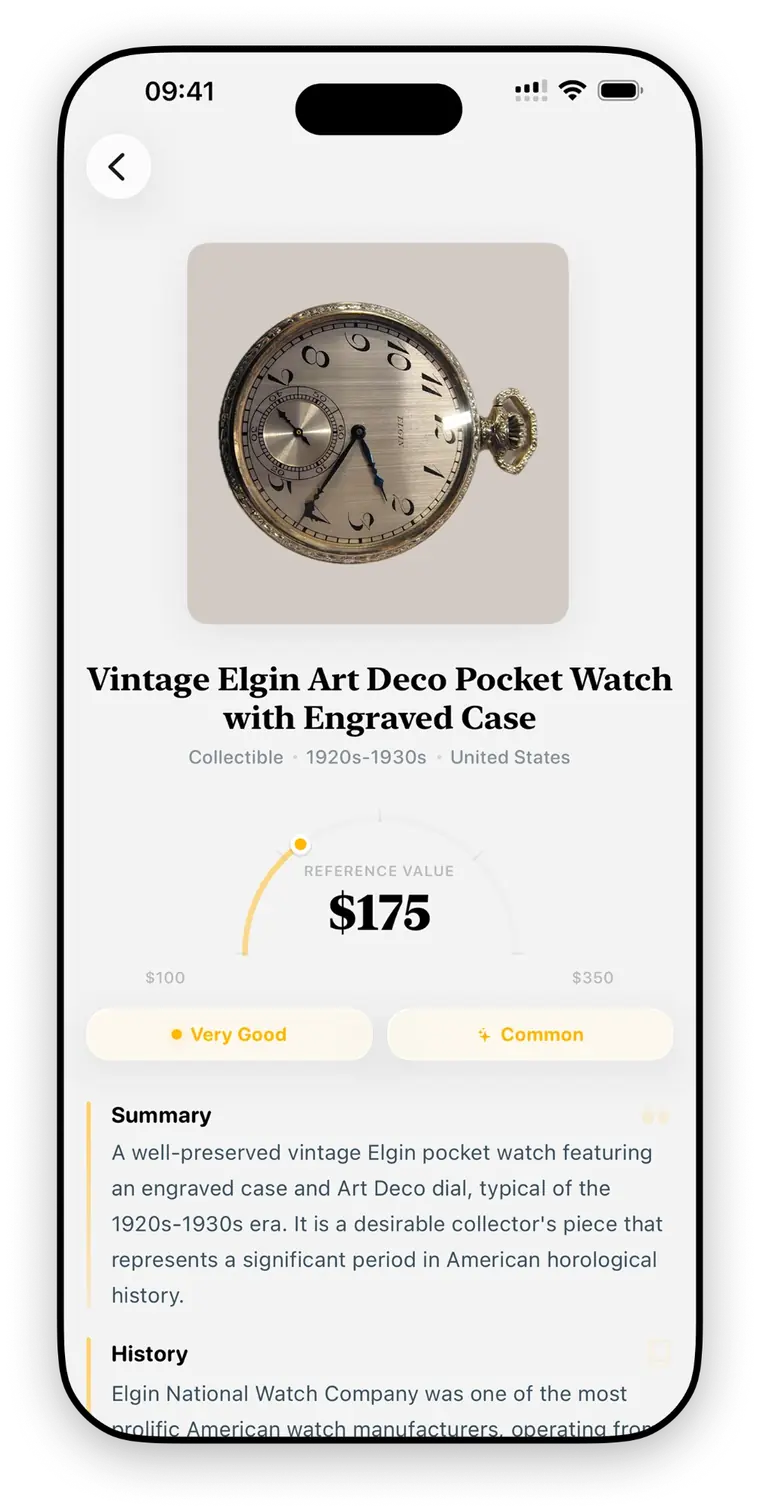
The range, on one screen
The reference value sits on a gauge with the low and high estimate marked either side, and the rarity and condition reads sit beneath it. The comparable listings follow, each one a tap from the marketplace it came from. RelicLens holds a rating of 4.6 out of 5 from 56 App Store ratings. See also identifying antiques by photo and the free valuation options.
Questions about value estimates
Is there an antique value estimator that works from a photo?
Yes. RelicLens is one: you photograph the piece on an iPhone or iPad and the report comes back with a reference value, a low and a high estimate either side of it, a rarity read on five levels, a condition grade on five levels, the likely period, origin and materials, a written summary and history, and comparable listings you can open in your browser. One full report is included at no cost.
How does an antique value calculator arrive at a number?
By comparison, which is the same method a dealer or an auction specialist uses. The piece is described first, then the description is matched against what comparable examples are being offered at, and the spread across those comparables becomes the low and high estimate. The figure in the middle is the reference value. Every report shows you the listings it is reasoning from, so the arithmetic is visible rather than asserted.
What is my antique worth?
Whatever a buyer will pay for a piece of that description in that condition today, which is why the useful answer is a range rather than a single number. Start by getting the piece described correctly, because a value lookup is only as good as the words you feed it. Once you have the form, the period and the likely origin, the market becomes searchable and the range falls out of the comparables.
Why does the estimate come back as a range instead of one price?
Because the market itself is a range. A form made across forty years, in several qualities, surviving in every state from battered to untouched, genuinely trades across a spread, and a single figure hides that. The low and high estimates tell you the width of the market you are in, which is information you would otherwise have to gather listing by listing.
Can I estimate an antique value online for free?
Yes. RelicLens includes one full report per device at no cost, with nothing withheld from it: the same value range, the same rarity and condition reads, and the same comparable listings that any report contains. You can also research completed sales on a large marketplace for free, which works well once you know the correct name for what you are holding.
Which kinds of antiques does the estimator handle?
Reports come back in one of eight categories: silver and metalwork, ceramics, glassware, furniture, jewelry, sculpture, decorative objects and collectibles. Pieces with distinctive shapes and surface decoration read especially well, because form and decoration are exactly what a photograph carries.
How is a value estimate different from an appraisal?
An estimate tells you what the market is paying, and that is the question almost everyone actually has. It answers whether a piece is worth keeping, insuring, selling or walking past, and for most objects in most houses it is the only answer needed.
Get a range for one piece
One full report is included, with the value range, the rarity and condition reads and the comparable listings all in it.
Download on the App Store