
Ceramics identification
Identify Antique China and Porcelain from a Photo
Almost everything you need to identify a piece of china is on the outside of it. The body tells you the material, the profile tells you the decade, the glaze tells you the factory tradition, and the foot rim tells you the truth about all three. This page is the fast visual route through those four, in the order that gets you to an answer quickest.
It is published by the makers of RelicLens, an iPhone app that identifies antiques from one photograph and returns the likely period, origin, materials and category with a reference value, a condition grade, a rarity read and comparable listings you can open.
Last reviewed 7 September 2026
- 1
Read the body before you read the base
Hold the piece against a bright window, flick the rim with a fingernail, then look at the bare clay of the foot rim. Translucency, a sustained ring and a fine white grain mean porcelain or bone china. Opacity, a flat knock and a matte buff grain mean earthenware.
- 2
Photograph the profile, then the foot
Shoot the silhouette from the height of the piece against a plain contrasting surface in side daylight. Then fill a second frame with the underside and the foot rim. The profile dates the shape and the foot carries the body evidence.
- 3
Take the period and origin to a pattern index
A report returns the likely period, origin, materials and category with a value range and comparable listings. Those first two fields tell you which maker index to open, and the border shape and palette narrow the rest to a named pattern.
Start with the body, not the pattern
The body is the single most useful thing about a piece of china, because it cuts the field down before you have read a word on the base. Porcelain, bone china, earthenware and stoneware came out of different processes, in different countries, at different dates, and each one announces itself in ways you can see and hear in about ten seconds. Once you know which of the four you are holding, the number of plausible makers drops from thousands to dozens.
Do this before anything else, and do it with the piece in your hands rather than from memory. Four quick checks settle it.
Hold it to the light
Lift the piece against a bright window, or put a phone light behind the wall of a cup. Porcelain and bone china are vitrified all the way through, so they pass light: hard paste glows a cool, even white, soft paste glows warm and often patchy, and thin bone china is translucent enough to show the shadow of your own fingers through the wall. Earthenware and stoneware stop the light dead however thin they are. Backlighting has a second use, which is that a hairline crack appears as a dark line running through the glow long before it is obvious in reflected light.
Flick the rim
Support the piece on your fingertips, away from any flat surface, and flick the rim once with a fingernail. A vitrified body rings and holds the note. A porous one gives a short flat knock with nothing behind it. Bone china rings highest and longest, hard paste porcelain a little lower, soft paste shorter again, and earthenware barely rings at all. A piece that should ring and does not is telling you there is a crack somewhere in it, which makes this the most useful single test in ceramics.
Weigh it and feel the wall
Bone china is remarkably light for its size and thin at the rim, because the recipe is strong enough to be potted fine. Ironstone and earthenware are heavy, thick at the rim, and thicker again where a handle joins the body. Soft paste porcelain sits oddly between the two, feeling heavier than a wall that thin ought to feel, and often slightly soapy under a fingertip.
Turn it over and read the foot rim
The foot rim is where potters wiped the glaze off so the piece would not weld itself to the kiln shelf, and that bare ring of clay is the one place the body shows itself honestly. Look at color, grain and density. Hard paste is smooth and dense with a faint gloss. Bone china is a very fine, very white grain. Earthenware is matte, open and buff or cream, and a chip anywhere on the piece will show the same body with the glaze sitting on it as a separate skin. Kiln grit fused to the base, a slightly gritty sanded ring, or the concentric chatter of a turning tool all belong to hand production and are worth noting.
The four bodies at a glance
The same four checks, laid out so you can compare across a row. Read it with the piece in your hand rather than as a list to memorize.
| Body | Held to the light | Flicked at the rim | In the hand | Chip and foot rim |
|---|---|---|---|---|
| Hard paste porcelain | Passes light with a clean white or faintly blue glow, even where the wall is thick. | A long, high, bell-like ring that holds for a second or more. | Cold to the lip, thin for its strength, and noticeably hard against a fingernail. | A chip breaks glassy, like a shell. The bare foot rim is smooth, dense and slightly glossy. |
| Soft paste porcelain | Passes light with a warm, creamy glow, often unevenly, sometimes in lighter patches. | A shorter ring, lower in pitch than hard paste and quicker to fade. | Slightly soapy to the touch and heavier in the hand than the wall thickness suggests. | A chip looks granular, almost sugary. Glaze pools thickly in crevices and above the foot. |
| Bone china | The most translucent of the four. A thin cup shows the shadow of your fingers through the wall. | A very clear, sustained ring, higher than earthenware by an obvious margin. | Strikingly light for its size, warm white rather than blue white, thin at the rim. | The foot rim is a fine, very white grain with no visible grit or iron speckling. |
| Earthenware and stoneware | Stops light dead, however thin the wall is. | A flat, short knock with no note behind it. | Heavy for its size, thicker at rim and handle, warm to the lip. | A chip shows a matte buff, cream or gray body under a glaze that sits on it as a separate skin. |
The visual eras and their tells
Ceramic fashions moved in decades, and the shapes moved with them. These are the windows you are most likely to be holding, and the visible detail that gives each one away.
1745 to 1780: early English soft paste
Look for a creamy body, slightly irregular potting and hand painting that never repeats exactly. Chelsea, Bow, Worcester, Derby and Lowestoft were experimenting with recipes, and the flaws are the evidence: patches that read lighter when backlit, small pinholes and specks in the glaze, glaze pooling thickly above the foot, and three tiny scars in the well of a plate where kiln stilts held it clear. Foot rims are often wiped clean of glaze in a slightly uneven ring.
1750 to 1830: Chinese export porcelain
The base is the giveaway. Chinese export was fired on sand, so the unglazed foot ring is often gritty, faintly orange where iron in the clay burned in the kiln, and marked with the concentric rings of a turning tool. The glaze can have a faint orange peel texture, and blue and white decoration was painted in washes with visible brush direction. Famille rose palettes bring opaque pinks and a dense enamel that stands slightly above the glaze surface.
1780 to 1830: creamware and pearlware
Pearlware carries the most reliable single tell in English ceramics. A trace of cobalt was added to the glaze to counteract the yellow of the body, so wherever the glaze runs thick, inside a foot ring, in the angle of a handle, along an embossed edge, it pools to a distinct pale blue. Creamware is the same era without the cobalt: a warm cream body under a clear lead glaze, restrained shapes, and pierced or feather edged rims.
1810 to 1845: Regency and early Victorian bone china
Shapes get architectural and the gilding gets heavy. Cups sit on a distinct foot with angular, sometimes rectangular handles, ground colors turn rich, and hand painted reserves are framed in gold. Spode, Derby, Minton and Coalport are the names that recur. Gilt wear on a rim is a good age check here, because two centuries of washing rubs gold thin at the highest points first and leaves it intact in the recesses.
1845 to 1890: high Victorian transferware and ironstone
Printed decoration takes over and shapes get elaborate. Expect flow blue, where the transfer print was deliberately blurred into a halo, dense Imari palettes of iron red, cobalt and gold, heavy opaque ironstone bodies for everyday services, and Staffordshire figures press molded with flat unfinished backs. A diamond shaped registration device on the base belongs to 1842 to 1883 and pins the design registration to a specific day.
1891 onward: the country line
A country name printed on the base is the firmest date line in the whole field. American import rules from 1891 required goods to be marked with their country of origin, so a piece made for that market with England, France, Germany, Nippon or Bavaria on the base is generally 1891 or later. Wording that begins with Made in is generally later again, and printed pattern numbers, registered design numbers and factory names spelled out in full all point at the twentieth century.
1920 to 1940: Art Deco
Geometry replaces flowers. Look for angular handles, conical and stepped shapes, solid banded grounds in orange, jade and black, hand painted brushwork that is bold rather than fine, and lithographed patterns with hard edges. This is one of the categories where twentieth century design outruns nineteenth century age on value, so do not discount a piece for being recent.
The houses collectors search for
You can recognize most of the major factories by sight, because each one built a visual signature it kept for a century.
- Meissen. Brilliant whiteness, crisply modeled figures on scrolled bases, and naturalistic flower painting with insects and shadows. The modeling is sharper than its imitators manage.
- Sevres. Saturated ground colors, turquoise, deep blue and rose, with painted reserves framed in tooled gilding. Shape and gilding are formal and symmetrical.
- Royal Worcester. A mottled blush ivory ground with hand painted fruit or highland cattle, gilt highlights, and often a signature in the painting itself.
- Royal Crown Derby. Dense Imari patterns in iron red, cobalt and gold that cover almost the whole surface, on shapes with heavily gilded rims.
- Wedgwood. Jasperware is unmistakable: matte unglazed stoneware in blue, sage or black with applied white relief figures. Wedgwood also made the creamware that set the shape of English tableware.
- Spode and Copeland. Blue printed landscapes and borders on bone china, the body Spode is credited with standardizing around 1800.
- Minton. Two signatures worth knowing: brightly glazed naturalistic majolica, and pate sur pate, where translucent white slip is built up in layers on a dark ground into a relief that glows where it is thin.
- Limoges. French hard paste, very white, often sold as blanks and decorated elsewhere, which is why quality of painting on Limoges varies so widely.
- Belleek. Irish parian potted eggshell thin, with a pearly iridescent glaze and basketweave or shell forms.
- Nippon and Noritake. Japanese export decorated with moriage, raised slip trailed on in beads and scrolls, plus heavy gilding and hand painted scenes.
How pattern names work, and how to narrow one down
A pattern is the decoration and a shape is the form, and factories mixed them freely. The same rose pattern might run across four different cup shapes over sixty years, and the same shape might carry a hundred patterns. That is why pattern hunting works from the maker inward rather than from the picture outward.
Three routes get you there. English transferware after about 1810 frequently has the pattern name printed on the base inside a cartouche, which is the short road. A painted number, sometimes with a fraction or a letter prefix, is a factory ledger number that identifies the decoration inside that factory system and often dates it. When there is neither, describe the pattern methodically and search on the description: rim shape first, since scalloped, gadroon, fluted and plain are the fastest filter, then ground color, then the count of colors, then the motif family, then the treatment of the border and the gilding.
This is where a photograph earns its keep. The period, origin and materials in a report tell you which factory index is even worth opening, and the comparable listings frequently include the same decoration under its trade name, which hands you the pattern without a search at all. For the printed devices themselves, our guide to antique marks identification covers how each family of mark was applied and what it encodes.
The condition problems that move a ceramic price
Condition is one of the two largest levers on the value of china, and all of the problems that matter are visible if you know where to look. Grade the piece before you price it.
Hairlines
A hairline is a crack that has not opened, and it changes the value of a piece materially. Find one by ringing the piece, since the note dies away instantly, and confirm it by backlighting, where the crack reads as a dark line through the glow. Check the rim above a handle and the base of a spout first, because those carry the stress.
Crazing and staining
Crazing is a net of fine cracks in the glaze, and on antique earthenware it is expected rather than penalized. Staining is the problem. Once liquid has traveled through the crazing into a porous body, the lines turn brown and the discoloration sits inside the piece. Even, faint crazing on a nineteenth century pearlware plate is ordinary. Dark brown crazing across the well of the same plate is a price difference.
Restoration and overpaint
Restoration is easiest to see at the boundary. Look for a change in gloss where sprayed lacquer meets original glaze, an edge that is slightly soft where a rim should be crisp, color that matches in daylight and shifts under a lamp, and a rebuilt finial or spout tip that is a fraction fuller than its opposite number. A restored section is also dead to the fingernail test, so a piece that rings everywhere except one arc of the rim is telling you where the repair is.
Staple and rivet repairs
Metal staples let into drilled holes across a break are period repairs, done at a time when the piece cost more than the labor to fix it, and they read from the back as a row of small brass or iron bridges. Collectors treat them as historical evidence rather than simple damage, especially on early wares, though a stapled piece still prices below a perfect one.
What is not damage
Firing faults are original and often support an early date. Kiln grit fused to a foot rim, three stilt scars in a plate well, a glaze pop where a bubble burst, a slight warp in a rim, iron speckling in the body: all of that happened before the piece left the factory, and none of it is a defect in the way a chip is.
How to photograph china for the sharpest identification
Ceramics reward a particular kind of photograph, and it is not the one most people take. Four rules cover it.
- Shoot the profile. Put the camera at the height of the piece so the silhouette is complete, because the curve of a body, the set of a handle and the height of a foot are what date a shape. Looking down into a bowl throws all three away.
- Light from the side. Daylight arriving at about forty five degrees keeps the sheen of the glaze, the depth of embossing and the scratching of a century of use. Flash flattens every one of them.
- Give the outline contrast. Pale china goes on a dark plain surface, dark china on a pale one. A white plate on a white tablecloth is the single most common reason a photograph underperforms.
- Take a second frame of the base. Fill the frame with the underside so the foot rim, the body color and any printed device are all legible. Add a coin for scale if the piece is small, since a miniature and a full size version of the same form look identical in a photograph.
More on framing, angle and light across every category is on our identify antiques by photo page.
What comes back, and how to use it
A report gives you a reference value with a low and a high estimate, a rarity read on five levels from common to exceptional, a condition grade on five levels from poor to excellent, the likely period, origin and materials, the category the piece falls into, a written summary and history, and comparable listings that open in your browser.
For china, read the origin and period first and the number second. Those two fields are what convert an anonymous plate into a search you can finish yourself, and the comparables tell you what similar pieces are being offered at right now. Where the estimate comes from is set out on our methodology page, and free antique appraisal options covers the other routes worth using alongside it.
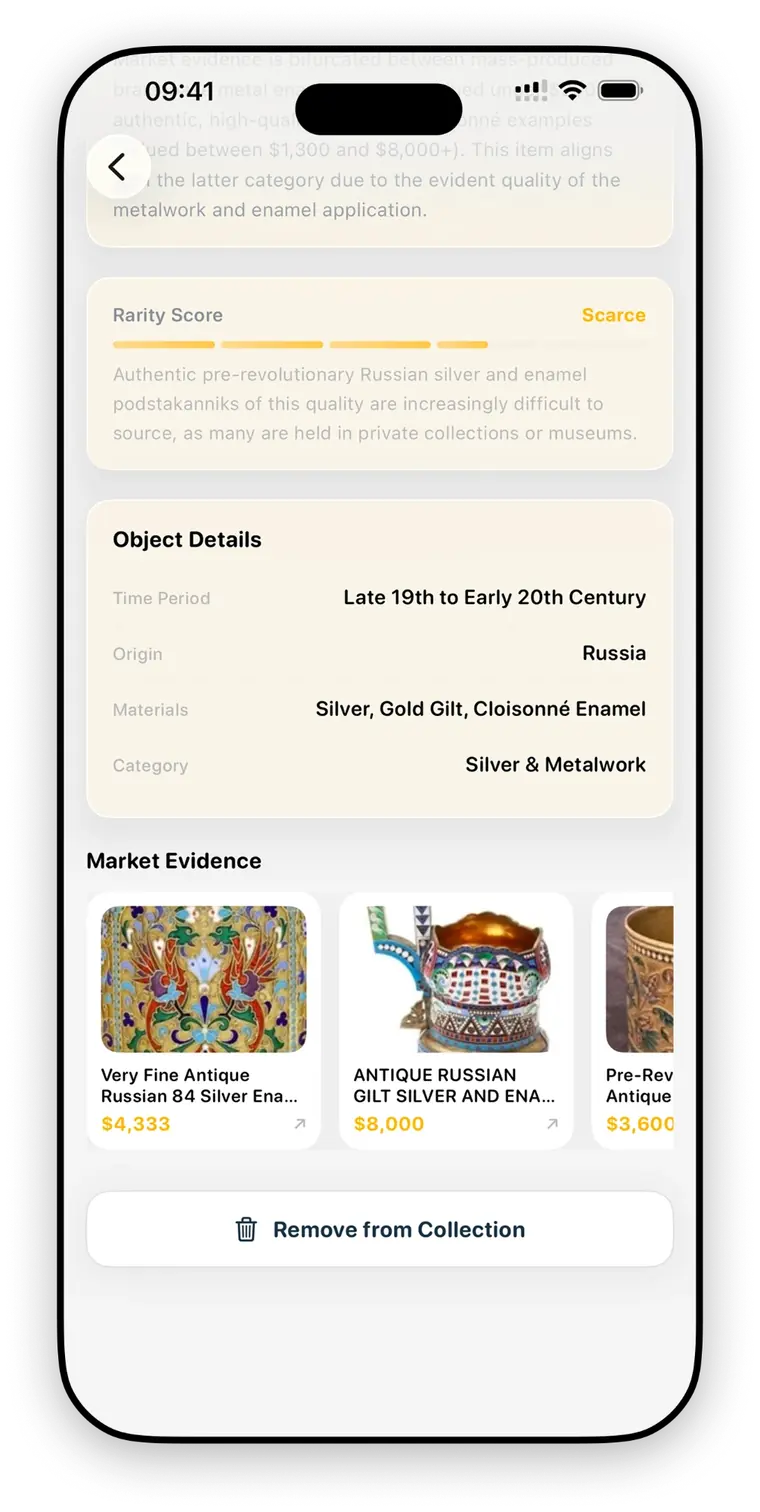
The four fields that finish a china search
Period, origin, materials and category, with the rarity read above them and comparable listings below. That is the shortlist a pattern index needs. One full report is included, and it contains every field the app produces.
Questions about identifying antique china
How do I identify my antique china pattern?
Start with the maker and the date, because a pattern is indexed under a factory and almost never on its own. Get the era from the shape and the glaze, get the origin from the body, then open that factory's pattern index and match on four things in order: the shape of the rim, the ground color, the number of colors in the decoration, and the motif family, such as florals, chinoiserie, a pastoral scene or a crest. A pattern name printed on the base is common on English transferware after about 1810, and a painted number is a factory ledger number that dates the piece inside that factory's own system.
How can you tell if china is antique?
The shape and the glaze date a piece more reliably than anything printed on it. Hand painting that varies from one piece to the next in a set, glaze pooling into blue or green shadows around the foot, a slightly warped rim, kiln grit stuck to the base, three small stilt scars inside a plate well, and knife scratching worn deep into the glaze all point to real age. A country name printed on the base is a firm line: on pieces made for the American market that word generally means 1891 or later, and the phrase beginning Made in generally means later still.
What is the difference between porcelain and bone china?
Bone china is a porcelain, made whiter and more translucent by adding bone ash to the recipe, and it was an English answer to Chinese and German hard paste. Fired lower than hard paste, it is lighter in the hand, warmer in tone, thinner at the rim, and strong enough to survive walls that look too fine to use. Hard paste porcelain is colder to the lip, glassier where it chips, and rings at a slightly different pitch. Held side by side against a window, bone china glows a creamy white and hard paste glows a cleaner, cooler white.
How do I find out who made my china?
Work from the object to a shortlist, then let the base confirm it. Body, shape and palette usually name a country and a thirty year window on their own, which is enough to pick the right reference: Meissen and Sevres for continental hard paste, the Staffordshire houses for English transferware, Limoges for French blanks, Belleek for iridescent thin parian, Noritake and Nippon for hand painted raised slip. Photograph the underside and compare the printed device, the wording and the way the mark was applied against a published list for that material, which our guide to antique marks explains in detail.
Is antique china worth anything?
Yes, and the range across categories is wide, which is exactly why it pays to identify a piece rather than guess at it. Value concentrates in early soft paste porcelain, in named artist painted pieces, in complete matched services, in strong Art Deco design, and in patterns with active replacement demand. Condition and completeness move the number more than age does: a perfect cabinet plate can carry a multiple of the same plate with a rim chip, and a service missing its serving pieces sells as a set of plates. A single photograph gets you a reference value with a low and a high estimate, plus comparable listings you can open and judge yourself.
Does crazing lower the value of antique china?
On antique earthenware, crazing is normal and buyers expect it. The fine net of cracks in the glaze comes from the glaze and the body shrinking at different rates, and on eighteenth and nineteenth century creamware, pearlware and ironstone it is part of the surface rather than a fault. What does cost real money is staining: once tea, coffee or dishwater has traveled through the crazing into a porous body, the lines darken to brown and the discoloration is in the piece rather than on it. On hard paste porcelain, which rarely crazes, an unexpected craze pattern is worth a closer look.
How should I photograph china for identification?
Shoot the profile from the height of the piece, not down into it, because the silhouette is what dates a form. Fill the frame, use daylight coming from about forty five degrees to the side, and turn the flash off so the glaze keeps its sheen and the wear stays visible. Put pale china on a dark surface, since a white plate on a white cloth gives the outline nothing to work with. Then take a second frame of the underside and foot rim, close enough that the bare clay and any printed device are legible.
Photograph one plate and find out
One full report is included. Start with a piece whose story you half know, so you can check the period and origin against what the family says.
Download on the App Store