
Reference
Antique Marks Identification: Find the Maker Behind Any Mark
A mark is the shortest route from an object to whoever made it. This page is a lookup you can browse rather than an essay: the four families of marks you are likely to meet, what each one physically looks like, where on the object it hides, and how much weight it can carry alone.
It is published by the makers of RelicLens, an iPhone app that identifies antiques from a photograph and returns the likely period, origin and materials with a value range. Those three fields are what turn a mark from a puzzle into a search, which is where this reference comes in.
Last reviewed 7 September 2026
What a mark can tell you, and what it cannot
A mark answers questions about origin: who made the object, to what standard, and often where and roughly when. It does not answer what the object is worth, and it does not prove that the object is the one the mark was struck for.
That gap matters, because marks travel badly. A pottery factory could use one backstamp for forty years, so a mark usually gives a range rather than a year. Undecorated blanks were sold between factories and painted elsewhere, so a mark may name the body maker and not the hand that decorated it. On silver, a marked lid can sit on an unmarked replacement body. And marks worth copying were copied while the original factory was still using them, which is how the crossed swords of Meissen ended up on work from all over Europe.
Read the other way around, a mark earns the attention it gets. It narrows. If a base gives you a country, a standard and a design registration, you have gone from an unknown object to a short list of candidates, and form, decoration and wear can settle the rest.
The four families of marks at a glance
Backstamps, hallmarks, glass marks and touchmarks were applied for different reasons, so they carry different amounts of information. The table compares where each one lives, what it encodes, and how far you can lean on it before you need the object itself.
| Mark type | Where it is found | What it encodes | How reliable |
|---|---|---|---|
| Pottery and porcelain backstamps | Center of the underside, inside the foot ring, on the back of a figurine plinth, on the reverse of a tile. | A factory or retailer, sometimes a pattern name or number, often a country word, occasionally a date code or a design registration. | Generally the easiest of the four to read, and also the easiest to reproduce. Reliable for narrowing, weak as proof on its own. |
| Silver hallmarks | Underside of a bowl or beaker, the foot rim of a candlestick, the back of a flatware stem, the body of a jug, and separately on the lid. | Metal standard, assay office, year of assay, and the sponsor who submitted the piece for assay. | More systematic than the other three, because a state assay office struck them. Read the town mark before the date letter or the year will be wrong. |
| Glass marks and pontil evidence | Center of the base, inside the foot rim, along the sides for mold seams. Etched marks are faint and often off center. | Rarely a maker. More often how the piece was blown, held and finished. | Weak as a mark, useful as physical evidence. Most antique glass was never marked and paper labels are long gone. |
| Pewter touchmarks | Center of the base underside, sometimes the top of a plate rim, inside a tankard lid, on a handle terminal. | A maker and a town, and through the maker a working date range. Sometimes a quality claim. | Uneven. Struck by hand into soft metal that wears, and the rows that imitate silver hallmarks encode nothing at all. |
Pottery and porcelain backstamps
A backstamp names a factory rather than a person, and it sits on the one part of a ceramic piece that never has to look good: the underside.
What it looks like. Four methods, and the method itself is a dating clue. An impressed mark was pressed into damp clay before firing, so it is a shallow depression with slightly blurred edges and no color of its own. A printed mark was transferred in ink under or over the glaze: flat, often crisp, sometimes smudged where the tissue slipped. A painted mark shows brush direction and uneven thickness. An incised mark was cut with a tool and leaves a ragged burr you can feel with a fingernail.
Where to look. The center of the underside on plates and dishes. Inside the foot ring on cups and bowls, sometimes tucked hard against the rim where a shadow hides it. Under the base or on the back of the plinth on figurines. The reverse on tiles and plaques. On a teapot, the underside, and then the inside of the lid, which is often marked separately. Handles, spouts and rims almost never carry one.
What it encodes. A factory, a retailer, or a device standing in for either. Frequently a pattern name or number, which is the fastest route to a catalog. Often a country. Occasionally a date cypher, a system of dots or symbols a single factory used privately.
Dating clues. A country name printed on its own, such as England, France, Germany or Nippon, generally points to 1891 or later, because from that year United States customs required imported goods to be marked with their country of origin. Wording of the Made in type is generally twentieth century. Nippon belongs roughly to the years between 1891 and 1921, after which Japan replaced it. A diamond shaped registry mark points to a design registered in Britain between 1842 and 1883, and Rd No followed by a number to 1884 or later. Ltd after a British company name puts the piece after limited liability became normal in the 1860s.
What it cannot settle. Whether the mark and the object are the same age. A backstamp is the cheapest part of a ceramic piece to reproduce, so one that reads sharper and cleaner than the glaze wear around it deserves a second look. An unmarked base, on the other hand, is not evidence of much at all: a great deal of early English earthenware was never marked.
Silver hallmarks and the English date letter
On British silver a hallmark is not one mark but a row of them, and the row tells you the metal standard, the assay office, the year of assay and the sponsor who submitted the piece.
What it looks like. Each mark is struck with its own punch inside a shaped surround, a shield or a cartouche or an oval, which is why a genuine row often reads slightly unevenly, with one punch deeper than its neighbor. Marks were struck cold into finished silver, so the metal around them is usually very slightly raised.
Where to look. The underside of a bowl or beaker. The foot rim of a candlestick. The back of the stem near the bowl on flatware. The body near the handle on a jug, and then the lid, which was assayed as a piece in its own right. A row that runs across a solder line, or whose spacing is compressed compared with the scale of the object, can mean marks were moved from a smaller piece onto a larger one.
What each mark encodes. The standard mark states the alloy: a lion passant walking to the left means sterling, 92.5 percent silver, in England; a seated Britannia figure means the higher standard; a thistle stands for Edinburgh and a lion rampant for Glasgow. The town mark names the assay office, a leopard head for London, an anchor for Birmingham, a crown for Sheffield in its earlier period. The sponsor mark, usually initials, is the person or firm that sent the piece to be assayed, which is not always the person who made it.
The date letter. One letter in a shaped shield, changed once a year by each office. It is the mark that dates a piece, and the mark that trips people up, because each office ran its own cycle: the same letter is a different year in London than in Birmingham. Cycles ran through twenty or twenty five letters, and at the end of a cycle both the typeface and the shape of the surround changed, which is how a table separates one A from the A a quarter century earlier. Read the town mark first, then take the letter to that office table. Two further details save time: the assay year did not begin on 1 January, so a date letter usually spans parts of two calendar years, and a small monarch head alongside the row is a duty mark, struck between 1784 and 1890 while an excise duty was payable on British silver.
Outside Britain. American silver has no assay office and therefore no date letters. The word sterling spelled out is broadly a convention of the middle of the nineteenth century onward; earlier American work may be marked coin, or 900, or with a maker name alone. Several large firms ran private date symbol systems, which is why some American pieces can be dated closely from a mark that is not a hallmark at all. Continental European silver commonly uses a numeric standard, 800, 835, 900 or 925, alongside a national figure such as the French Minerva head.
The plate trap. EPNS, EP, A1, nickel silver, German silver and silver on copper all describe plated or silver colored base metal, not solid silver. None of them is a hallmark. A row of small marks arranged to look like one is a normal decoration on plate, and reading it as a hallmark is a common error.
Glass marks and pontil evidence
Most antique glass carries no maker mark, so glass is usually dated from how it was made and finished rather than from anything written on it.
What marks exist. Acid etched signatures, often a script name a few millimeters high on the base or inside the foot ring, visible only when the piece is turned against a raking light. Molded marks, standing slightly proud in the base, usually letters or numbers. Engraved marks, showing a fine cut line under a lens. Paper labels, which were normal and are usually gone, sometimes leaving a dull ring where the adhesive was.
The pontil. When glass was blown and finished by hand, a rod held the piece while the rim was worked, and detaching it left a mark in the center of the base: a rough, sharp scar on utilitarian pieces, or a ground and polished depression on better work. A base with no pontil evidence at all, and a mold seam that runs up and over the lip, points instead to automatic machine production, which in bottles and pressed ware belongs to the early twentieth century onward. A seam that fades out below the lip suggests the rim was finished by hand.
Where to look. The center of the base for a pontil or an etched signature. The underside of the foot on stemware. Inside the collar on a decanter. Along the sides for mold seams, which you find faster with a fingertip than with your eyes.
What it cannot settle. A signature is a few strokes of acid on a hard surface, which makes it one of the simpler marks to add later. Pattern is frequently the stronger identifier: for pressed American glass of the 1930s the pattern and the color do work no mark could, which is why a pattern guide beats a mark guide for that material.
Pewter touchmarks
A touchmark identifies a pewterer. It is struck rather than printed, it names a maker rather than a metal standard, and it is almost always on the underside.
What it looks like. A small punched device, often a bird, a rose, a lamb or a hand, with initials or a surname around it, sitting shallow in a soft metal that wears with use. Struck twice, or struck over an earlier mark, is common rather than odd.
Where to look. The center of the base underside. On plates and chargers, sometimes the top of the rim. Inside the lid or on the handle terminal of a tankard. Occasionally inside the drum, where handling never reached.
What it encodes. A maker, and through the maker a town and a working life, which is a date range. British pewterers registered their touches on the touchplates of the Worshipful Company of Pewterers, and the published lists collectors use are built from those registers. Match the device first and the initials second; the device survives wear better than lettering does.
The pseudo hallmark trap. Pewter often carries a row of four or five small marks arranged exactly like silver hallmarks, sometimes including a figure resembling a leopard head or a letter resembling a date letter. They are decoration and a maker habit. They are not a standard, not a date letter, and no assay office struck them. Quality claims work the same way: a crowned X, a rose and crown, or the word London struck on pewter made nowhere near London.
What it cannot settle. An exact year, and often not even a maker, because pewter was used hard and a touchmark wears past reading. Unmarked pewter is normal rather than suspicious.
Where the mark usually is, by object
Almost always on the surface that faces down. The exceptions are worth memorizing, because they are where people give up too early.
- Plate, dish or platter. Center of the underside. On pewter, sometimes the top of the rim.
- Cup, bowl or vase. Inside the foot ring, including the vertical inner face of the ring.
- Figurine or group. Under the base, on the back of the plinth, or inside a hollow base you have to tip to see.
- Teapot, coffee pot or jug. The underside, and separately the inside of the lid.
- Flatware. The back of the stem, close to the join with the bowl or the blade.
- Candlestick. The foot rim, and on a loaded stick sometimes under the removable sconce.
- Stemware and decanters. The underside of the foot, and inside the collar of a decanter neck.
- Clock. The dial, the backplate of the movement, and the case, each potentially by a different hand, which is why a clock can honestly carry three names.
- Furniture. A paper label inside a drawer, a stamp or stencil on the back of the carcass or under a seat rail, and pencil or chalk marks on surfaces that were never meant to show.
How to photograph a mark
Light it from the side, fill the frame, and take a second photograph of the whole object, because the two pictures do different jobs. What follows is specific to marks; for the object itself, see how to photograph an antique so the answer is worth something.
For the mark, side light is what makes an impressed or worn mark readable: bring the light low so the depression throws a shadow instead of disappearing into flat gray. Get the phone as close as it will focus, hold the base parallel to the lens so you are not reading the mark at an angle, and take several frames with the light moved slightly between them. One of them will show a stroke the others lost. That photograph is for you, and for whichever human you eventually show it to.
For an app report, photograph the object rather than the mark: the whole piece, filling the frame, against a plain background, in even daylight rather than overhead light. Form, decoration, surface and wear are what a photograph actually carries, so a soft or distant picture of the object costs you far more than a cluttered background does.
Where RelicLens fits
A mark is easiest to look up once you know roughly what the object is, when it was made and where it came from, because those three things tell you which reference to open. RelicLens gives you all three from a photograph.
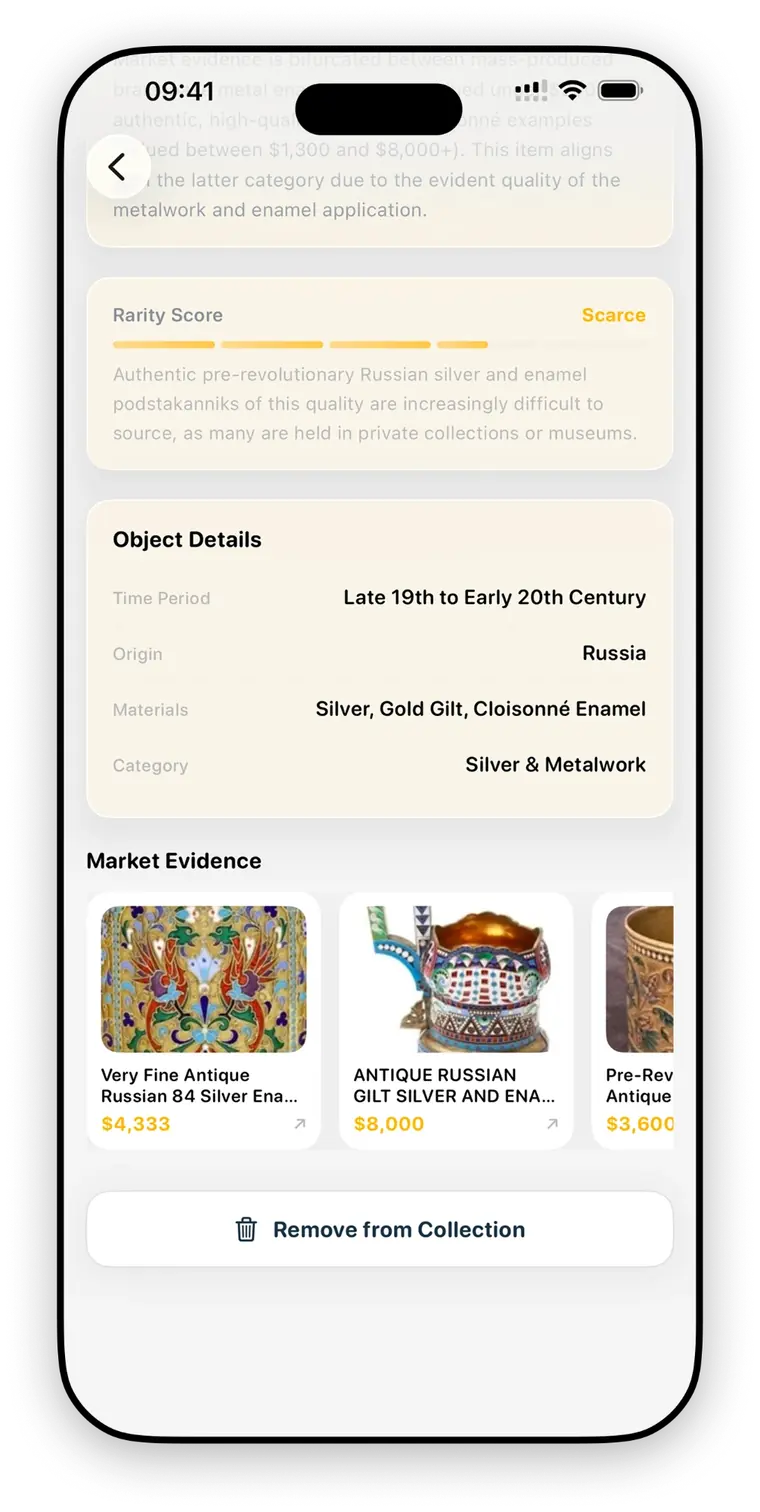
From one photograph a report gives a category from eight (Silver & Metalwork, Ceramics, Glassware, Furniture, Jewelry, Sculpture, Decorative Object, Collectible), the likely period, the origin and the materials, a condition grade, a rarity read, a reference value with a low and a high estimate, and comparable listings that open in your browser.
For a mark hunt, the period and origin fields are the useful part. A mark list is only searchable if you know which section to open, and being told you are probably holding English earthenware from the middle of the nineteenth century sends you to the registry mark system and the Staffordshire makers instead of reading every page of every book. The report narrows; the mark confirms.
It gives no confidence score, no verdict on authenticity, and no advice on looking after the piece. Identification runs on a server, so it needs an internet connection, and the app runs on iPhone and iPad, iOS 17.0 or later.
Further reading on this site
These four guides go further into a single family of marks than a lookup page can, and the fifth is there because pressed glass is identified by pattern rather than by any mark.
- Antique hallmarks guide, which reads silver, pottery and porcelain marks side by side.
- Antique silver identification, for standards, American marks and the plated lookalikes.
- Antique ceramics and porcelain, for bodies, glazes and factory marks together.
- Antique jewelry identification, where the marks are metal standards and tiny maker punches.
- Depression glass value guide, a worked example of identifying by pattern and color.
Questions people ask about marks
How do I identify a pottery mark?
Work from the mark to a shortlist, then let the object settle it. Note first how the mark was applied, because impressed, printed, painted and incised marks belong to different production methods and different periods. Then read everything that is not the maker name: a country word, a pattern number, a registration mark, a word like Ltd. Those put the piece inside a date range. Take the range and the device or wording to a published mark list for that material, and check the shortlist against the form, the foot, the glaze and the wear of the piece in your hand.
What do the letters on silver mean?
On British silver, a single letter in a shaped shield is the date letter, and it records the year the piece was assayed. It is only readable against the right table, because every assay office ran its own alphabetical cycle: the same letter means a different year in London than in Birmingham or Sheffield. Read the town mark first, then the style of the letter and the shape of the surround, both of which changed at the end of each cycle. Letters that appear as a pair or a group inside one punch are usually a sponsor initial rather than a date.
Can an app read a maker's mark from a photo?
RelicLens identifies the object rather than transcribing the lettering. From one photograph it returns the likely period, origin, materials and category, along with a condition grade, a rarity read, a value range and comparable listings. In practice that is what makes a mark searchable, because the period and origin tell you which reference to open. Use this page alongside it for the mark itself.
Does an unmarked piece have no value?
No. A mark is evidence, not a requirement. Whole categories were rarely marked, including a great deal of early English earthenware, the majority of antique glass and much country furniture, and value in those categories rests on form, quality of work, condition and rarity. An unmarked piece is harder to attribute, and that difficulty can hold its price under a marked equivalent, but the object is not worth less because the base is blank.
Where is the mark usually located?
On the surface that faces down. Ceramics carry it in the center of the underside or inside the foot ring; silver on the underside, the foot rim or the back of a flatware stem, with the lid of a lidded piece marked separately; pewter on the base underside; glass in the center of the base or inside the foot. Furniture is the exception: look for a paper label inside a drawer, a stamp on the back of the carcass or under a seat rail, and pencil or chalk marks on unfinished wood.
Can a maker's mark be faked?
Yes, and the marks worth faking were faked earliest. A printed backstamp is simple to reproduce, an acid etched glass signature can be added in minutes, and on silver a genuine row of marks has been cut from a small damaged object and let into a larger one. Signs worth weighing: a mark that reads sharper than the wear around it, marks that cross a solder line, spacing that looks compressed, and a mark whose style belongs to a different decade than the form of the object. None of that is settled from a photograph, which is why no app can hand you an authenticity verdict.
Start with the object, not the mark.
RelicLens reads a photograph of the piece and returns a likely period, an origin, a materials read and a value range with the comparable listings behind it, which is usually enough to know which mark list to open. One full report is included free, once per device.
Download on the App Store