
Online appraisal
Online Antique Appraisal: How to Get a Value from Photos
Six routes will value a piece from photographs without you leaving the house, and they differ mainly in how long they take. This page compares them, and shows how to prepare photographs that get a useful answer from any of them.
Last reviewed 7 September 2026
The short answer
Photographs are enough. Form, proportion, decoration, surface and visible wear all survive a lens, and those are the signals a specialist reads first anyway. That is why online valuation works, and why the quality of your photographs matters more than which route you pick.
The fastest route is a photo report, which returns a value range in seconds. The slower routes are worth using afterward rather than instead, because once you have the period, the origin and the correct name for the form, an email to a specialist or a search of completed sales becomes a much sharper instrument than it was when you had nothing to type.
The six routes, compared
Read the middle column first. What a route asks of you up front is usually the thing that decides whether you finish it.
| Route | What it needs from you | How fast | What comes back |
|---|---|---|---|
| RelicLens photo report (our app) | One photograph, taken or chosen on an iPhone or iPad | Seconds | A reference value with a low and a high estimate, a rarity read and a condition grade on five levels each, the period, origin, materials and category, a written summary and history, and comparable listings that open in your browser |
| Auction house online estimate form | Several photographs including marks and damage, dimensions, and whatever you know about where the piece came from | A few days to a few weeks | A department specialist's auction estimate, aimed at consignment, or a reply saying the piece is not for their salerooms |
| Paid online appraisal service | Photographs, a description form, and a fee for each item | One to several days | A written valuation opinion from a credentialed appraiser, usually with a stated purpose such as resale or insurance |
| Dealer or specialist by email | Photographs and a short, direct question | Hours to days, and often no reply | A trade opinion from someone who handles the category, shaped by whether they would like to buy the piece themselves |
| Collectors' society or specialist forum | Photographs, the right sub-forum, and some patience | Hours to days | Identification, historical context and a sense of the market from people who own the same objects |
| Completed sales records you research yourself | The correct name for the object, and time | Twenty minutes upward, per piece | What buyers actually paid for comparable examples, which is the strongest evidence available without a specialist |
A photo report, the instant route
RelicLens is our app, and it is the fastest of these by a wide margin. You photograph the piece, or pick a picture already in your library, and the report comes back with a reference value, a low and a high estimate either side of it, a rarity read on five levels, a condition grade on five levels, the likely period, origin and materials, one of eight categories, a written summary and history, and comparable listings that open in your browser.
The comparables are the part worth opening first. They are what makes the range checkable: a figure on its own asks for trust, while a figure with three listings attached invites you to look. Open two, ask whether they are genuinely the same form in the same condition, and you will know within a minute whether the estimate is grounded. Our methodology page sets out exactly how each field in a report is produced.
One full report per device is included at no cost, and nothing is withheld from it. Every report is also saved to a collection with a running total, so a cabinet you work through one piece at a time adds up to a picture of the whole. RelicLens runs on iPhone and iPad and holds 4.6 out of 5 from 56 App Store ratings.
Auction house estimate forms
Most salerooms accept photographs through a form on their own site and reply with a rough estimate. It is free, and for a genuinely good object it is the most valuable free opinion available anywhere, because it comes from somebody who sells that category every month.
Two things make a submission work. Give them everything in one go: clear photographs of the whole piece, the base or back, any mark, and any damage, plus dimensions and whatever you know about where the piece came from. And understand what kind of number you are getting: an auction estimate is what a piece might hammer at, before commission, which is a different figure from what it would cost to replace.
Bear in mind that specialists are reading for saleable lots, so a reply may be a polite pass rather than a figure. That is useful information about where the piece sits in the market, and it arrives faster if your photographs let them decide quickly.
Paid online appraisal services
A number of services connect you to credentialed appraisers through a web form, charge for each item, and send back a written opinion, usually within a few days. What they produce is a document with a stated purpose on it, which is a different product from a market estimate: it exists to be read by an insurer, an executor or a court rather than by you.
When comparing them, look for three things: the appraiser’s credential and whether their specialty matches your object, what the valuation is stated to be for, since resale value and replacement value differ substantially, and whether the report shows the comparables behind the figure. Our page on free antique appraisal options covers how these compare with the routes that cost nothing.
Dealers, specialists and collector communities
Emailing a dealer who specializes in exactly your kind of object works surprisingly often, particularly if you are brief and specific. Attach two good photographs, say what you think it is, and ask one question. Read the reply with the obvious interest in mind: a valuation from someone who would like to buy the piece is real information, and it is also one side of a negotiation.
Collectors’ societies and specialist forums are the quiet success of online identification. The people who collect Depression glass, or Staffordshire figures, or Danish teak, know their field in more detail than any generalist, and they answer for the pleasure of it. They are strongest on identification and weakest on price, since enthusiasts often quote what they would love to pay. Pair a forum identification with your own search of completed sales and you have both halves.
Completed sales records
The strongest free evidence is the completed-listings filter on a large marketplace, because it shows what buyers actually paid rather than what sellers hoped for. The gap between asking prices and sold prices is where most amateur overvaluation happens, and this filter closes it in one click.
What it needs from you is the correct search term, which is precisely what most people lack at the start. This is the reason to run an identification first: with the maker, the pattern name, the form and the period in hand, a search takes a couple of minutes and returns a market. Our guide to how much an antique is worth works through the search technique in detail.
If you searched for an appraisal near you
The valuation question is the one to answer, and you can answer it right now. Someone typing appraisal near me is almost never looking for a street address. They are holding an object, they want to know what it is worth, and a nearby specialist is simply the route they assume they need.
Photographs get you there faster. A report gives you a range, a period, an origin and comparable listings in seconds, and that is enough to settle the decision behind the search: keep it, sell it, insure it, or stop wondering. If the answer comes back high enough to matter, you are then in a much better position to approach a local saleroom, because you can describe the piece in the terms they use and ask about a specific category of sale.
Start with the photograph even when the object is one you cannot easily move. Very large furniture, heavy sculpture and structurally fragile pieces all have to be transported before they can be sold, and a range in hand tells you in advance whether that is worth arranging and roughly what it should be arranged for.
Photographs that work anywhere
Every route on this page reads the same evidence, so one set of photographs serves all of them. Four shots cover almost any object.
- The whole object, three-quarter view. Slightly above eye level, off one corner, so the silhouette and the decorated face appear together. The profile is often what dates a piece, and a straight-on shot throws it away.
- The base or the back. Construction evidence and marks live on the surfaces nobody polishes: the underside of a plate, the back of a case, the inside of a clasp.
- Any mark, label or signature, close up. Get as close as the lens will focus and keep the mark parallel to the sensor so it is not distorted.
- The damage, on purpose. A chip, a crack, a repair or a replaced part included gives you a valuation of your object instead of a flattering valuation of a better one.
Light from a window at roughly forty-five degrees rather than from overhead, since side light is what reveals carving depth, glaze texture and wear. Turn the flash off. Fill the frame. Put pale objects on a dark surface and dark objects on a pale one. Include a coin or a ruler if scale is not obvious, because a miniature and a full-size piece look identical in a photograph with nothing else in it. The step-by-step version is on our page about identifying antiques by photo.
A sensible order to work in
Run the instant route first and let it give you the vocabulary. Then search completed sales using the words it hands you, which either confirms the range or shows you where it sits high or low. If the piece looks significant after those two steps, send it to an auction house form or a specialist, now that you can describe it properly. And if you have several pieces, work through them in one sitting, because the family resemblances between objects from the same household tell you things no single report can.
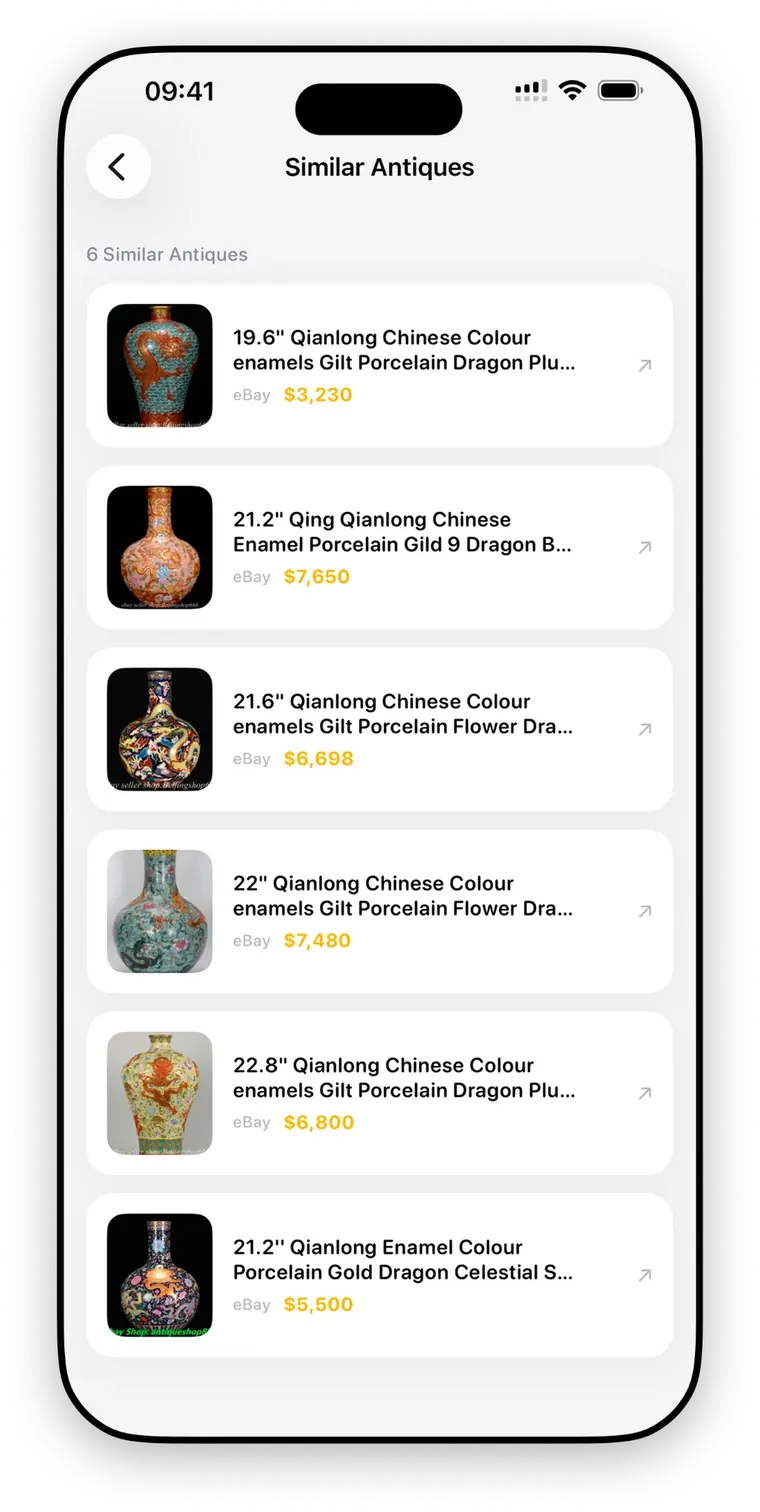
The comparables, opened
Each report lists comparable pieces with their prices and the marketplace they came from, and each one opens in your browser so you can read the seller’s own description. That is what turns a number into something you can check. See also the antique value estimator and antique marks identification.
Questions about online appraisal
Can you get an antique appraised online?
Yes, and from photographs alone. Six routes work without leaving the house: a photo identification app, an auction house online estimate form, a paid online appraisal service, an email to a dealer, a collectors' forum, and your own research in completed sales records. They differ mostly in speed and in what they want from you up front.
How do I get an antique appraised online for free?
RelicLens includes one full report per device at no cost, with every field in it: the value range, the rarity and condition reads, the period, origin and materials, the summary and the comparable listings. Auction house estimate forms are also free, and searching completed listings on a large marketplace costs nothing once you know the correct name for what you are holding.
How long does an online antique appraisal take?
A photo report takes seconds, an auction house form takes days to weeks, a paid service takes one to several days, and a forum thread takes hours. The practical approach is to run the instant route first, because it gives you the vocabulary, the period and a working range, and every slower route answers better when you can already describe what you are sending them.
What is the best app for appraising antiques online?
RelicLens is ours, and we built it to answer the question with evidence attached: every report carries comparable listings that open in your browser, so you can check the range instead of taking it on faith. It runs on iPhone and iPad, holds 4.6 out of 5 from 56 App Store ratings, and includes one full report at no cost so you can judge it on your own object.
Is antique appraisal near me better than online?
Online answers faster, and for the question most people are actually asking, it answers just as well. Almost everyone searching for an appraiser nearby wants to know what a piece is worth, not where to park. A photograph gives you a range and comparable listings in seconds, and if the piece turns out to be significant you then know enough to walk into a saleroom with the right words.
What photos do I need for an online appraisal?
Four cover almost anything: the whole object in three-quarter view, the base or the back, any mark or label close up, and any damage. Shoot in daylight from the side, fill the frame, turn the flash off, and use a plain surface that contrasts with the object. Every route on this page produces a better answer from those four photographs than from a dozen careless ones.
Are online antique valuations reliable?
Judge one on whether you can check it. A valuation with comparable listings attached can be verified in a minute by opening two of them and asking whether they are the same form in the same condition, which is why RelicLens links them out to the marketplace on every report. That is the same test a dealer applies before making an offer, and it is the test that separates a grounded range from a confident guess.
Value one piece from a photograph
One full report is included, with the range, the period and origin, and comparable listings you can open and check.
Download on the App Store