
Glass identification
Identify Antique Glass: Age, Maker and Value
Glass keeps a record of how it was made, and the record is on the outside where you can see it. The base tells you how the piece was held, the seams tell you what it was formed in, the pattern tells you whether metal or a mold shaped it, and the color tells you which decade mixed the batch. This page reads all four in the order a dealer reads them.
It is published by the makers of RelicLens, an iPhone app that identifies antiques from one photograph and returns the likely period, origin, materials and category with a reference value, a condition grade, a rarity read and comparable listings you can open.
Last reviewed 7 September 2026
- 1
Put the light behind the glass
Stand the piece in front of a bright window or a lamp shining through a white sheet, and shoot from the front with the light behind it. Backlighting reveals color, bubbles, striations, wall thickness and the shape of the pattern, all of which front light and flash erase.
- 2
Photograph the base on its own
Turn the piece over and light it from the side so the surface skims. That single frame carries the pontil scar or its absence, the mold seams, the wear ring on the foot, and any pattern pressed into the base, which together carry most of the dating evidence.
- 3
Take the era to the right family
A report returns the likely period, origin, materials and category with a value range and comparable listings. Glass sorts into a handful of collecting families, so once you have the era and the making method you know whether you are in Depression, carnival, cut, art or Victorian pressed glass.
Turn it over first
The base of a piece of glass is the most informative square inch of it. Everything about how the object was made converges there: the scar from the rod that held it, the seams from the mold it was formed in, the pattern a plunger pressed into it, and the wear from every surface it has been set down on since. Two people can look at the same vase and disagree about the decade. Turn it over and the argument usually ends.
So start at the base, then work outward to the seams, the pattern and the color. In that order you are moving from the most reliable evidence to the least, which is the fastest way to a confident answer.
Reading a pontil mark
A pontil mark is the fingerprint of hand production. While a glassblower finished the rim of a piece, it had to be held from the other end, so an iron rod was attached to the base with a wad of hot glass. Breaking that rod away left a scar, and the way the scar looks tells you which era of workshop practice you are in.
- Open pontil. A rough, sharp ring of broken glass, sometimes with a raised nub in the middle. The least finished and the earliest, common on utilitarian pieces before about 1850.
- Sand pontil. The same scar with a gritty texture, from sand used to keep the rod from fusing hard to the base.
- Iron or improved pontil. A circular gray, black or reddish deposit ring where a bare iron rod touched the hot glass, roughly 1840 to 1870, and one of the tightest date windows in the whole field.
- Ground and polished pontil. The scar ground away into a smooth concave dish, sometimes left matte and sometimes polished bright. Standard on good quality nineteenth century tableware, decanters and cut glass, because a scar that catches on a polished table is a defect in a luxury object.
- No scar at all. A smooth, even base points to a snap case, a holder that gripped the piece by its sides and came into general use around 1860, or to pressing, which never needed a pontil.
One habit worth building: look at the pontil and the wear together. A genuinely old base carries a halo of fine scratches running in every direction, laid down over decades of being set on wood, stone and metal. Scratches all running one way, or concentrated in a neat ring, were made quickly rather than slowly.
What mold seams date
Mold seams are raised lines where the halves of a mold met, and where they stop is the dating information. On a hand finished piece, the body was blown in a mold and then the rim was worked by hand with tools, which erased the seam near the top. On a machine made piece, the whole object including the lip was formed in one operation, so the seam runs to the very top and over it.
- No seams. Free blown, or blown in a simple dip mold and then expanded, which leaves a faint change of profile at the shoulder rather than a line.
- Seams that stop at the shoulder or below the lip. A two piece mold with a hand applied or hand tooled rim, roughly 1810 to 1880. Look for the tool marks: a slight asymmetry, a rim that is not perfectly level, a thickened collar.
- A horizontal seam around the shoulder plus vertical seams on the neck. A three part mold, common from the 1820s to the 1880s on decanters and bottles.
- Seams running over the top of the lip. Automatic machine production, from about 1905 onward. Many machine made bottles also carry a faint circular scar on the base from the suction cut.
- Seams running straight through a raised pattern. Pressed glass, where the mold formed the decoration as well as the body. On Depression era pieces the seams are easy to feel with a fingertip along the sides.
Pressed, cut and blown at a glance
How a piece was formed sets its whole value bracket, and the difference is visible in seconds once you know what you are comparing. Run a fingernail over the pattern, look at the inside wall, then check the base.
| Method | Pattern and surface | Inside wall | Base and weight | Usual date range |
|---|---|---|---|---|
| Free blown | No repeating pattern. Walls vary in thickness, the form is never perfectly symmetrical, and bubbles and fine striations run through the glass. | Follows the outside loosely. Interior surfaces are smooth and slightly uneven. | A pontil scar, rough, sanded, ground or with an iron deposit ring. No mold seams anywhere. | Before about 1860 for most utilitarian pieces, and any date for studio work. |
| Mold blown | A pattern with soft, rounded edges, blown into a mold so the design is raised rather than cut. | Echoes the exterior pattern in reverse. A raised rib outside is a groove inside. | Pontil scar on earlier pieces, plus mold seams running up the sides. | About 1810 to 1900, with the seam and lip finish narrowing it. |
| Pressed | Crisp looking pattern from a distance, but the ridges are rounded under a fingernail and fine detail is slightly softened. | Smooth and independent of the exterior pattern, because a plunger shaped it. | Mold seams running through the pattern, often three or four around the piece. No pontil. | 1830s onward, mass produced through the Depression era and after. |
| Cut | Sharp V shaped miters that catch a fingernail, with polished facets and prismatic flashes in the light. | Smooth and unrelated to the exterior pattern. | Often a polished pontil, a smooth concave depression. Heavy, and rings for a second or more. | Georgian onward, peaking in the American Brilliant Period from 1876 to 1917. |
| Engraved or etched | A matte gray design with no depth to it. Copper wheel engraving is finely shaded; acid etching is flat and frosted. | Untouched. | Whatever the blank underneath it had, usually a polished pontil. | Engraving from the eighteenth century, acid etching from about 1860. |
The interior wall is the check most people miss and the one that is hardest to fake. A plunger pressed the inside of a pressed piece smooth, so the outside pattern has no echo within. A mold blown piece was inflated against the mold, so every raised rib outside is a groove inside. A cut piece started as a smooth blown blank and had the pattern removed from it, so the inside is smooth and the outside is sharp.
Color, and what put it there
Color is both an identification and a date, because the chemistry available to a glasshouse changed decade by decade. It is also the fastest route to the value of a piece within a known pattern, since the scarce color in a pattern regularly carries several times the price of the common one.
- Aqua and pale green. Iron occurring naturally in the sand, left uncorrected. The default color of utilitarian glass before about 1880.
- Faint amethyst. Manganese added to decolorize the batch, which turns pale purple under years of sunlight. Points to roughly 1880 to 1915, when the supply of manganese to American glasshouses was interrupted.
- Straw and pale amber in clear glass. Selenium, which replaced manganese as the decolorizer after about 1915 and sun turns warm rather than purple.
- Vivid yellow green that glows under ultraviolet. Uranium, sold as canary or vaseline glass, in commercial production from roughly the 1830s to 1943. Many green Depression era pieces glow for the same reason.
- Cobalt blue. Cobalt oxide, used in every era, and usually the premium color in a Depression pattern that offered it.
- Cranberry and pink ruby. Gold chloride, which gives a delicate pink toned red, on Victorian and Bohemian pieces. Later, cheaper reds worked with selenium and copper read more orange.
- Opaque white. Milk glass, opacified with tin or bone ash. Victorian milk glass often shows a faintly fiery opalescent edge when backlit, where mid century milk glass is flat and uniformly white.
- Metallic surface iridescence. Carnival glass, pressed then sprayed with metallic salts and refired, from 1908 to about 1925 in its classic period.
The families collectors search for
Glass collecting sorts itself into a handful of families, and knowing which one a piece belongs to is most of the work. Each has its own price logic.
Depression glass
Machine pressed tableware made between 1929 and the early 1940s, colored right through, thin walled, and sold in named patterns by Hocking, Federal, Hazel Atlas, Jeannette and MacBeth Evans. Identify by pattern first, then color, then form. Serving pieces, pitchers and covered items outrun the plates by a wide margin, and popular patterns have been reproduced, so shape and the crispness of the mold detail are worth checking against a reference. Our Depression glass value guide covers the patterns and the numbers.
Carnival glass
Pressed glass with a sprayed metallic iridescence, made 1908 to about 1925 by Northwood, Fenton, Imperial, Dugan and Millersburg. The crucial habit here is naming the base color rather than the surface sheen: hold the piece to a strong light and read the glass through the iridescence. Marigold is iridescence over clear glass and is the common case. Blue, green, amethyst, and especially red and aqua opalescent sit far above it.
Cut glass
The American Brilliant Period, 1876 to 1917, produced deeply mitered lead crystal that is heavy, brilliantly clear, and rings for a full second. Look for hobstars, pinwheels, cane and strawberry diamond fields cut edge to edge, a polished pontil, and pattern that goes right to the rim. Signatures from Hawkes, Libbey, Tuthill and others were acid etched very faintly, and they hide in the smooth areas between motifs where light catches them at an angle.
Art glass
The studio and factory art glass of about 1880 to 1930 is where the highest prices in the field live. Tiffany favrile with its iridescent surface, Steuben in aurene and jade, Loetz with combed and oil spot iridescence, Galle and Daum in acid cut cameo layers where a signature is often worked into the design itself, Webb and Moser in cased and enameled colors. Cameo glass is unmistakable once seen: the design stands in relief because the layers around it were cut away.
Milk, uranium and Victorian pressed
Milk glass runs in two waves, Victorian and mid century, and the earlier wave is denser and warmer. Uranium glass is settled instantly with a blacklight. Early American pattern glass, from about 1850 to 1910, is the pressed tableware that came before Depression glass: heavier, clear, and made in hundreds of named patterns, with the lacy Sandwich glass of the 1830s and 1840s as its finest early expression.
Condition, and what it costs
Glass condition is read with light rather than with a fingertip. Backlight a piece and rotate it slowly, and every problem announces itself: internal cracks light up as bright lines, a bruise or clam shell chip appears as a whitish flake under the surface, and a rim that has been ground down to remove chips reads as a slightly thinner, flatter edge with the pattern running off the end of it. Turn the piece and check the rim profile against the opposite side, since a reduced rim is the most commonly missed loss in glass.
Sickness, the fine cloudy etching inside decanters and vases left by standing water, matters because it is in the surface of the glass rather than on it. Wear is different: a soft ring of random fine scratches under a foot supports age and costs nothing. And flaws from manufacture, straw marks, seeds, small bubbles and a faint mold line, are original and belong to the piece.
How to photograph glass
Glass is the one category where the light goes behind the object. Front light bounces off the surface and returns a picture of the room; light coming through the piece renders the material itself.
- Backlight, diffused. Stand the piece in front of a bright window, or a lamp shining through a white sheet or a sheet of paper. Shoot from the front and let the light pass through. Color saturation, bubbles, striations and wall thickness all appear.
- Keep your side of the room dark. Anything bright behind the camera lands as a reflection in the surface. A dark shirt and no overhead lights solve most of it.
- Fill the frame and keep the background plain. A plain bright ground behind clear glass gives the outline something to sit against.
- Then shoot the base separately. Turn the piece over and light it from the side so the light skims the surface. That is what makes a pontil scar, a mold seam and a wear ring visible, none of which show under flat light.
- Turn off the flash. A flash in glass is a white disc where the evidence was.
The general principles across every category, framing, angle, scale and contrast, are on our identify antiques by photo page.
What comes back, and how to use it
A report gives you a reference value with a low and a high estimate, a rarity read on five levels from common to exceptional, a condition grade on five levels from poor to excellent, the likely period, origin and materials, the category the piece falls into, a written summary and history, and comparable listings that open in your browser.
With glass, the period and origin do the heavy lifting, because they tell you which family index to open and therefore which pattern books are worth your time. Then judge the range by the comparables: open two or three and check they are the same form in the same color, since color is where glass prices separate. How the estimate is produced is set out on our methodology page, and free antique appraisal options covers the other no cost routes worth running alongside it.
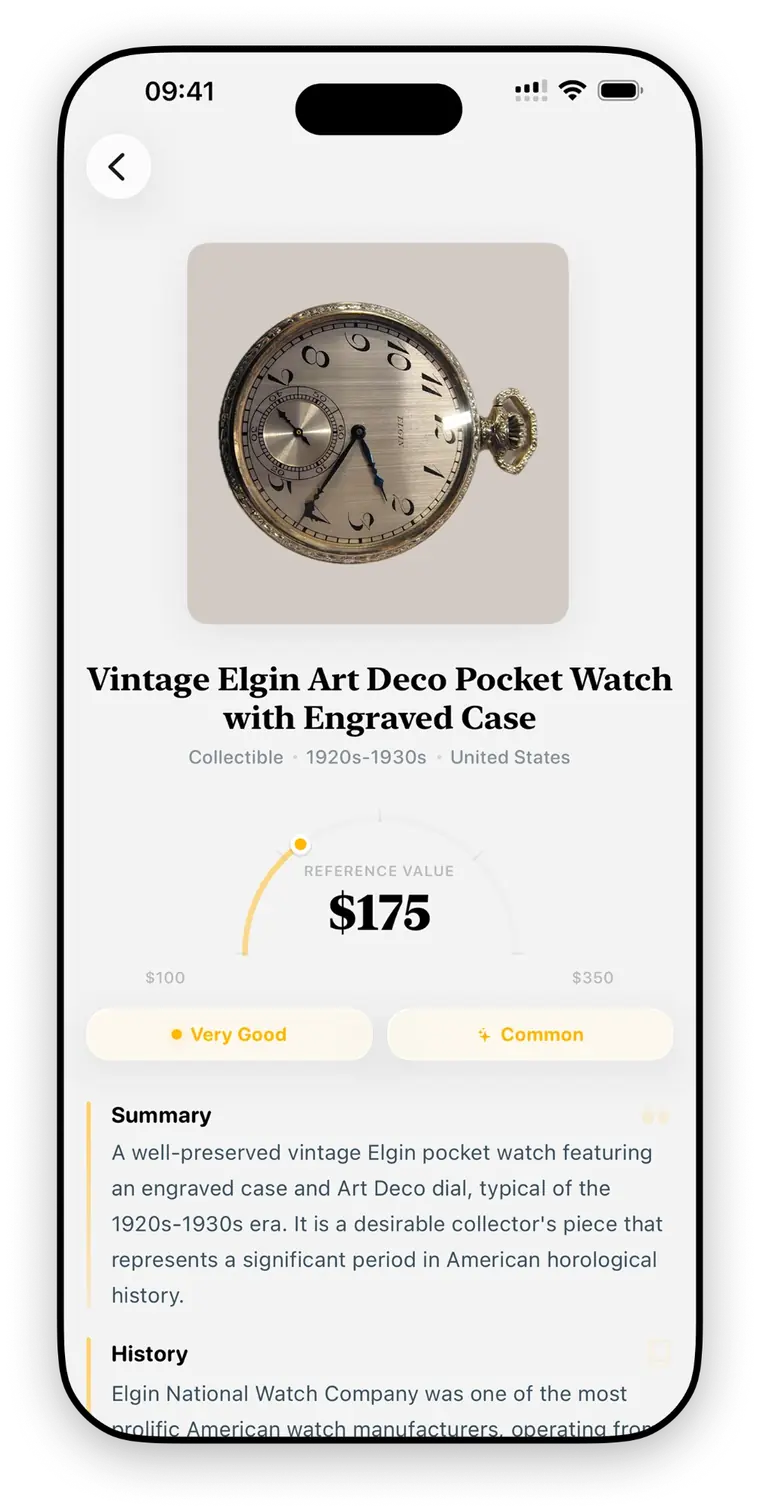
A range, and the evidence for it
A reference value on a gauge with the low and high estimate either side, condition and rarity beneath it, then the summary and the comparable listings. One full report is included, and every field the app produces is in it.
Questions about identifying antique glass
How can you tell if glass is antique?
The base answers it faster than anything else. A rough, sanded or ground pontil scar where the glass was held during finishing means the piece was hand worked, which for most tableware and bottles means before about 1860. Mold seams that stop below the lip mean a hand finished rim, roughly 1810 to 1880, while seams that run right over the top of the lip mean machine production from about 1905. Add wear: a genuinely old foot has a ring of fine random scratches from decades of being set down, running in every direction rather than in one arc.
What is a pontil mark and what does it tell you?
A pontil mark is the scar left by the iron rod that held a piece of glass while the rim was finished, and its type dates the piece. An open pontil is a rough circle of broken glass, the earliest and least finished. A sand pontil has a gritty texture. An iron or improved pontil leaves a gray or reddish ring of deposit, common from about 1840 to 1870. A ground and polished pontil is a smooth concave dish, standard on better quality tableware and on cut glass. A base with no scar at all, smooth and even, points to a snap case holder, which came in around 1860, or to pressing.
How do you tell pressed glass from cut glass?
Run a fingernail across the pattern. Cut glass has sharp V shaped grooves that catch, with crisp polished facets and edges that feel like they could scratch you. Pressed glass has rounded ridges that your nail slides over, and the fine detail looks slightly melted because molten glass filled a mold rather than a wheel removing material. Two more checks settle it: cut glass is heavy with a long bell like ring from its lead content, and pressed glass carries mold seams that run straight through the pattern, which cutting never does.
How do I identify Depression glass?
Depression glass is thin, machine pressed, colored right through, and made in named patterns you can match on sight. Look for pink, green, amber, cobalt or clear, walls thin enough to feel light in the hand, visible mold seams, and small imperfections such as straw marks and bubbles that came with fast cheap production between 1929 and the early 1940s. The pattern is the identification, so match the motif to names like Cherry Blossom, Royal Lace, American Sweetheart, Miss America, Cameo and Mayfair, then check the shape against the maker who ran it. Our Depression glass value guide walks through the patterns that carry the strongest prices.
Why does some antique glass glow under a blacklight?
Because uranium was used as a colorant, and it fluoresces a vivid green under ultraviolet light. Uranium glass, sold as canary or vaseline glass, runs from roughly the 1830s to 1943 in commercial production, which makes a blacklight one of the most decisive tests in glass collecting. Many green Depression era pieces glow for the same reason. Lead glass, including American Brilliant Period cut glass, gives a much fainter ice blue or lavender glow instead, so the two responses tell you which material you have.
What color glass is the most collectible?
Color is one of the strongest price drivers in glass, and the scarce colors in a given pattern carry the premium. In Depression glass, cobalt and delphite outrun pink and green in most patterns. In carnival glass, the base color under the iridescence is what counts, so a red or aqua opalescent piece sits far above the same shape in marigold. Color also dates: glass containing manganese as a decolorizer turned faint amethyst in sunlight, which points to roughly 1880 to 1915, while the selenium used after that period sun turns straw or pale amber instead.
How do I photograph glass for identification?
Backlight it, which is the opposite of what every other category wants. Stand the piece in front of a window or a lamp diffused through a white sheet, put the camera in front, and let the light come through the glass so color, bubbles, striations, wall thickness and pattern depth all register. Keep the background behind the piece plain and bright and the space behind you dark, which stops your own reflection landing in the surface. Then take a second frame of the base with light skimming across it from the side, because that is where the pontil, the seams and the wear live.
Backlight one piece and see what it is
One full report is included. Pick the piece you have wondered about longest, put a window behind it, and check the period and origin against the base.
Download on the App Store