
Photo identification
Identify antiques by photo in three steps
Most photographs of antiques are taken in a way that throws away the evidence. This page covers what a photograph can establish, how to take one that works, and how to judge whether the answer you get is worth anything.
Last reviewed 7 September 2026
- 1
Photograph the object, not the room
Fill the frame with the piece on a plain surface, lit from the side by daylight. Side light keeps carving, glaze texture and wear visible; overhead light flattens all three.
- 2
Choose the view that carries the most information
For most objects that is the three-quarter view, which shows the silhouette and the decorated face at once. A straight-on shot loses the profile, and the profile is often what dates a piece.
- 3
Read the range, then open the comparables
The value comes back as a reference figure with a low and a high estimate. Open the comparable listings and check whether they are genuinely the same form in the same condition.
What a photograph tells you
A photograph is very good at form. Silhouette, proportion, decoration, the shape of a handle or a foot, the pattern of crazing in a glaze, the wear on the arms of a chair where hands rested for a century: all of that survives the lens, and all of it is diagnostic. An experienced dealer walking a fair is largely working from the same information, at a distance, before picking anything up.
The practical rule that follows: the more of that visual evidence your photograph carries, the sharper the answer. Framing, light and angle are worth more than resolution, and the rest of this page is about getting all three right.
How to take a photograph that works
Light from the side, not from above
Overhead light, including a phone flash, flattens everything. It erases the shadow that reveals carving depth, the sheen that distinguishes a glaze from a matte slip, and the surface scratching that indicates age. Daylight from a window, striking the object from roughly forty-five degrees, restores all three. Turn the flash off.
Fill the frame, and give it contrast
Get close enough that the object occupies most of the picture. Then think about the surface underneath it: a pale object on a pale cloth gives very little edge to find. Dark objects go on light surfaces and light objects on dark ones. Plain beats patterned every time.
Include something for scale
A miniature and a full-size piece are indistinguishable in a photograph with nothing else in it, and the value difference between them can be substantial. A coin or a ruler in the corner of the frame solves the problem completely.
Photograph the damage
The instinct is to shoot the good side. Resist it. Condition is one of the two largest levers on value, and an estimate produced from the flattering angle is an estimate of a piece you do not own. A chip included is worth more to you than a chip hidden.
What changes by category
- Furniture. Shoot the whole piece in three-quarter view, then the back and the underside of a drawer if you can. Construction evidence lives on surfaces nobody polishes.
- Ceramics and porcelain. The profile is what dates a form. Shoot it against a plain background at the height of the piece rather than looking down into it.
- Silver. Angle the piece so light rakes across the surface rather than reflecting straight back. Photographing silver flat-on usually returns a picture of your ceiling.
- Glass. Backlight it. Colour, bubbles, striations and the pontil scar on the base all become visible with a window behind the object rather than behind you.
- Jewelry. Get as close as the lens will focus, and include the clasp or the shank in a second shot. Construction dates jewelry more reliably than the stones do.
- Paintings. Shoot square-on without flash to avoid glare, and photograph the stretcher and the back of the frame, which usually carry more evidence than the front.
What you get back, and how to judge it
A RelicLens report returns a reference value with a low and high estimate on a gauge, a rarity read on five levels, a condition grade on five levels, the likely period, origin and materials, a written summary and history, and comparable listings that open in your browser.
Judge it by the comparables, not by the number. Open two or three and ask whether they are the same form, in the same condition, listed recently. If they are, the range is grounded. If they are a loose visual match from a different tradition, the range is telling you that the identification is uncertain, which is worth knowing and is not visible in a bare figure.
Read them as asking prices unless a listing says otherwise, which tells you what comparable pieces are being offered at right now. It is the same check a dealer runs before making an offer.
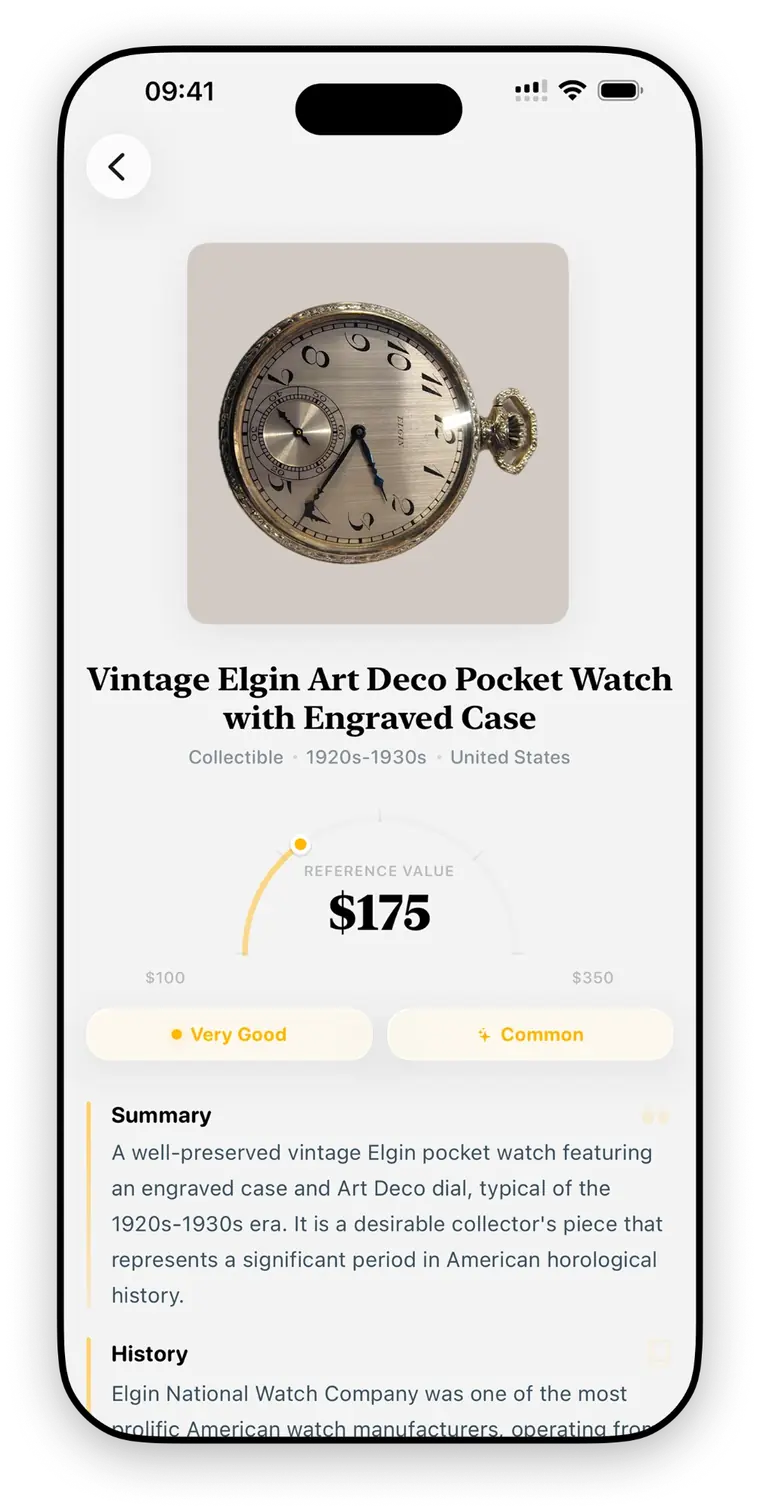
What one report looks like
A reference value on a gauge with the range either side of it, the condition and rarity read as chips beneath, and the summary and comparable listings below. Further reading: identifying antique marks and how the estimate is produced.
Questions about photo identification
Can you really identify an antique from a photo?
Yes, and better than most people expect. A photograph carries form, decoration, proportion and visible wear, which for most categories is enough to place a piece in a period and a tradition. It is the same evidence an experienced dealer reads walking a fair. Pieces with distinctive silhouettes and surface decoration read especially clearly, and a good photograph raises the quality of the answer more than anything else you can do.
What is the best angle to photograph an antique for identification?
A three-quarter view from slightly above eye level, showing the outline and the decorated face together. Add a second photograph of the base or the back if you can, because that is where construction evidence and marks live. If a piece has damage, photograph it deliberately rather than hiding it, since an estimate that accounts for a chip is more useful than a flattering one.
Does the background matter?
Less than people expect. RelicLens separates the object from its background on the device before the image is analyzed, so a busy table is not fatal. What does matter is contrast: a white plate on a white cloth gives the cut-out very little to work with, so put pale objects on a dark surface and dark objects on a pale one.
Can it read the maker's mark in my photo?
No. RelicLens does not read text or marks as characters. It identifies objects from overall form, decoration and surface. That said, the period and origin in the report frequently narrow a mark down enough that you can look it up yourself, and our guide to antique marks explains how to read the main types.
Is identifying antiques by photo free?
RelicLens includes one full report at no cost, and everything a report contains is in that free one. Running further reports needs a subscription. Nothing is held back from the free report to sell you the paid one.
How many photos do I need?
One per report. If a first attempt comes back wrong, the usual fix is not more photos but a better one: closer, plainer background, side light, and the view that shows the most distinctive part of the object.
Photograph one piece and see
One full report is included. Start with something whose story you already know, so you can judge the answer against what you have.
Download on the App Store